How to Build a Readership From Scratch
By The PageSwipe Team · 16 July 2026
Almost every author who now has thousands of readers started with a handful — often just friends, family, and the odd stranger who wandered in. Building a readership from scratch is not a trick you pull off once; it is a habit you keep for a long time. This guide is the honest version: what actually works when you start at zero, roughly how long it takes, and where a home base for your book helps and where it plainly does not.
The short answer
You build a readership from scratch by showing up consistently in one place, giving real value before you ask for anything, and turning attention into an audience you own. Concretely: pick a single platform you can sustain, start an email list early, engage honestly in communities where your readers already are, and treat your first few readers as advocates who recommend you onward. It compounds slowly — think months and years, not weeks — and the authors who win are usually the ones who simply did not stop.
TL;DR
- Pick one platform you can post to for a year without burning out. One done well beats five done thinly.
- Start an email list on day one, even at zero subscribers. It is the audience you actually own.
- Give value first — teach, entertain, or share the craft — long before you ask anyone to buy.
- Go where readers already gather and be a real participant, not a walking advert.
- Turn first readers into advocates. A small group who love the book and tell others beats a large indifferent following.
- Give the book a home base where those readers can gather and recommend it onward — club by club.
- Be patient. The first hundred true readers are the hardest; word of mouth starts slowly, then compounds.
First, the honest part: nobody hands you readers
Before the playbook, one thing worth saying plainly, because a lot of marketing pretends otherwise. No platform, ad, or app can manufacture a readership for you. Tools can make your reach more efficient, give your book a proper home, and help a recommendation travel further — but the reaching out, the showing up, and the writing worth talking about are yours to do. Hold every tactic in this guide to that standard: does it help real people choose to read you, or does it just promise a crowd?
That reframing is freeing. It means the lever is in your hands: you do not need to get lucky with an algorithm, only to be consistent, useful, and worth recommending — and to give the small group who like your work an easy way to pass it on.
The long game: what building a readership actually looks like
A readership is not an audience you buy; it is trust you accumulate, and it grows in three overlapping stages.
- Presence (roughly months 0–6). You choose your platform, start your list, and begin showing up. Numbers are tiny. This stage feels like shouting into an empty room, and that feeling is normal — you are building the habit and the back catalogue of posts that later readers will find.
- Traction (roughly months 6–18). A few readers start to reply, share, and come back. Your list creeps upward and you begin to recognise names. This is where consistency pays its first dividend — and where most people quit right before it does.
- Compounding (roughly month 12 onward). Word of mouth begins to carry weight. Readers recommend you to other readers, and each new book launches to a warmer room than the last. Growth stops being purely manual.
Those windows are illustrative, not promises — genre, how much you publish, and how often you show up all move them. But the shape is remarkably consistent: slow, then steady, then compounding. Plan for the slow part so it does not surprise you into stopping.
The step-by-step playbook
1. Choose one platform and go deep
The instinct at zero is to be everywhere at once. Resist it. Spreading thin across five platforms is how you end up posting badly on all of them and building an audience on none. Pick one place your readers actually spend time and that you can stand to use for a year — a newsletter, one social network, a blog, a video channel, whatever fits your work and temperament. Depth on one platform earns a real audience; a shallow presence on five earns a scattering of followers who never become readers.
How to choose: go where your genre already congregates, then filter by what you can sustain. If you dread video, do not build on video. The best platform is the one you will still be showing up on in month eleven.
2. Start an email list before you feel ready
This is the single highest-leverage move, and the one new authors most often postpone. Social platforms rent you attention and can change the rules or vanish; an email list is an audience you own and can reach directly, forever. Start it on day one, even with zero subscribers. Add a sign-up wherever you appear, offer a genuine reason to join — a short story, a sample chapter — and email your list on a rhythm you can keep.
A hundred engaged email subscribers who chose to hear from you are worth more than ten thousand passive followers. When you launch, this is the list that shows up first and tells everyone else.
3. Give value before you ask for anything
The fastest way to be ignored is to show up only when you have something to sell. The fastest way to be remembered is to be consistently useful or entertaining before any ask — teach something about your craft, share the honest bits of the writing life, recommend other people's books generously. The goal is that people are glad to see your name in their feed or inbox, because when the launch comes, glad-to-see-you is what converts into readers. A cold audience does not.
4. Engage in communities where readers already are
You do not have to build every room yourself. Readers already gather — genre forums, book clubs, reader groups, comment threads, local library and bookshop events. Show up as a real participant: answer questions, join conversations, be a person, not a billboard. Over months this earns the kind of familiarity that makes people curious about your book without you ever hard-selling it. Two honest rules keep this from going wrong: never spam a group with your own links, and give far more than you take.
5. Give your book a home base readers can gather around
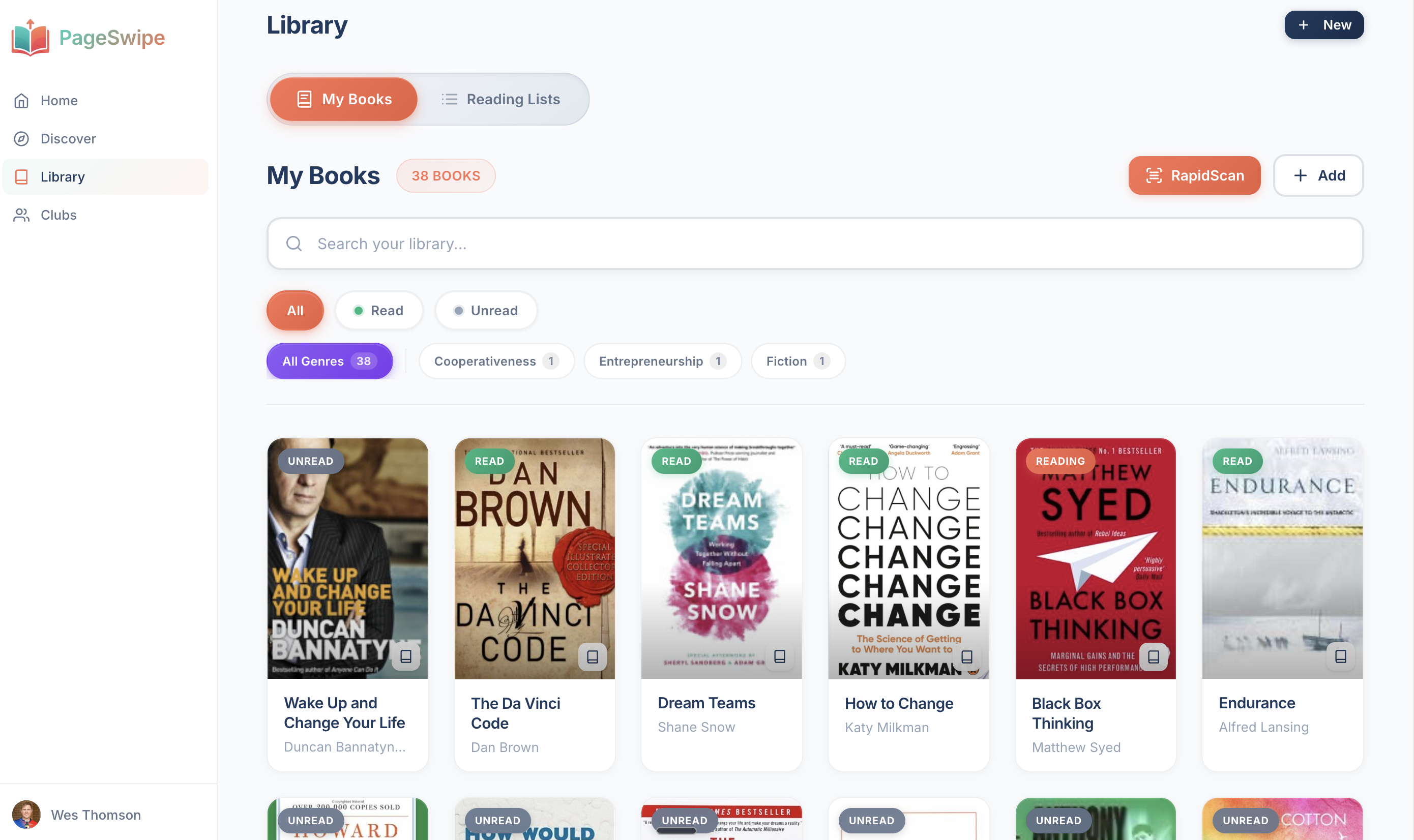
Attention is fragile. Someone hears about your book in a group chat, means to look it up, and forgets by evening. A permanent home base — a page holding the cover, description, buying and reading links, and a place for readers to talk — catches that attention before it evaporates, and gives your keenest readers somewhere to do something: join a discussion, answer questions, bring a friend.
This is where a purpose-built author tool earns its place, and where we should be exact about what it does. With PageSwipe for authors you can create an official book page and a launch club around it, add discussion questions, and invite the readers you already have. Readers who join can then recommend the book onward to their own clubs and circles. To be completely honest about the mechanics: PageSwipe does not supply readers — it gives the book a home where the readers you invite gather, and it helps their recommendations spread from one small club to the next. You do the reaching; the tool helps the momentum travel. You can see how that fits a from-zero author on the indie author platform overview.
6. Turn your first readers into advocates
PageSwipe is a free platform for readers and authors: scanning, cataloguing, sharing, lending, clubs, collections, discovery, book pages, and launch clubs are not gated. PageSwipe earns revenue through book-native advertising with authors and publishing houses at scale.
7. Keep going long enough for it to compound
The uncomfortable truth is that most of building a readership is simply not quitting. The authors who "came out of nowhere" almost always spent one to three quiet years showing up before anyone noticed. Set a cadence you can actually hold — weekly, fortnightly, whatever is real — and protect it over intensity. A year of steady, modest effort beats a fortnight of frantic launch energy followed by silence.
A realistic first-year roadmap
Here is one honest shape for a first year at zero. Treat it as a map, not a guarantee — your genre, output and time will move the milestones.
| Phase | Rough window | Focus | Honest expectation |
|---|---|---|---|
| Foundation | Months 0–3 | Pick one platform; start the email list; set a posting cadence; set up the book's home base. | Very small numbers. This is groundwork, not growth. |
| Presence | Months 3–6 | Give value consistently; join two or three reader communities; invite your first readers to the home base. | First real replies and sign-ups. Still manual. |
| Traction | Months 6–12 | Deepen relationships; nurture early advocates; make recommending effortless. | Word of mouth starts. A small, loyal core forms. |
| Compounding | Month 12+ | Launch to a warm list; let readers spread the book club by club; repeat with the next book. | Growth stops being entirely on your shoulders. |
Illustrative timeline only. Some authors move faster, many move slower, and both are normal. The one variable you fully control is whether you keep showing up.
Mistakes that keep authors stuck at zero
- Trying to be everywhere. Five thin channels beat by one deep one, every time. Choose.
- Delaying the email list. "I'll start it when I have something to say" means starting it far too late. Start now.
- Only showing up to sell. If your last five posts were all asks, you have trained people to ignore you.
- Chasing follower counts over real readers. Ten people who finish and recommend your book matter more than a thousand who liked a post.
- Quitting during the quiet stretch. The slow middle is not failure; it is the part right before it works.
- Believing a tool will hand you an audience. It will not. Use tools to help readers spread the word — never as a substitute for the reaching out.
Where PageSwipe fits — and where it doesn't
To keep this honest, here is the plain version. PageSwipe is a good fit once you have some readers, even a handful, and want a durable place for them to gather and a way for their enthusiasm to travel. You create a free official book page and a launch club, add discussion questions, and invite the readers you already have; those readers can recommend the book into their own clubs, and it spreads club by club. Creating that home base is free — cataloguing and clubs are not gated.
Where it is not the answer: if you have nobody to invite yet, no tool fixes that — do the foundational work in this guide first, then give the readers you earn a home. PageSwipe is not an advertising network or an audience you can rent; it is the home base and the onward-recommendation layer, not the crowd. It helps your readers multiply your reach; it does not create readers out of thin air.
Frequently asked questions
How do you build a readership from scratch?
You build a readership from scratch by showing up consistently in one place, giving genuine value before you ask for anything, and slowly turning attention into an owned audience. In practice that means choosing a single platform you can sustain, starting an email list early, engaging honestly in communities where your readers already gather, and treating your first handful of readers as advocates who can recommend you onward. It is a long game measured in months and years, not weeks, and there is no shortcut that reliably skips the consistency.
How long does it take to build a readership?
Realistically, expect the first year to feel slow and the compounding to start somewhere in year one to year two of steady effort. Many authors find their first hundred true readers take longer to earn than the next few hundred, because early growth is manual and word of mouth has not started yet. Timelines vary enormously by genre, output and how often you show up, so treat any specific number with caution and focus on the habit rather than the deadline.
Do I need a big social media following to build a readership?
No. A large following helps, but plenty of authors build durable readerships from a small, engaged base. What matters more is an owned channel you control — an email list or a home base for your book — and a small group of readers who genuinely like your work and tell others. Reach you rent on a social platform can vanish overnight; readers who chose to hear from you do not.
Does PageSwipe give me an audience of readers?
No. PageSwipe does not supply or manufacture readers, and no honest tool can. What it gives you is a home base — an official book page and a launch club — where the readers you invite can gather, talk about the book, and recommend it onward into their own circles and clubs. You still do the reaching out; PageSwipe helps the momentum you create spread from one small group of readers to the next.
What is the first thing I should do to build a readership?
Start an email list and pick one platform you can post to consistently, even if only a dozen people ever see it at first. An owned list is the foundation everything else compounds on, and one platform done well beats five done thinly. Everything after that — communities, a book home base, first-reader advocates — builds on those two habits.
Related guides for authors starting at zero
Start where you actually have control
Building a readership from scratch is slow, human work that rewards the authors who keep showing up long after the excitement fades. You cannot buy a crowd, but you can earn a first reader, look after them, and give them an easy way to bring the next one. That is the whole game, repeated patiently until it compounds.
When you are ready to give your book a home the readers you earn can gather around and recommend onward, create your free PageSwipe book page and start turning your first readers into a club that spreads the word.