Where Can New Authors Share Their Books?
By The PageSwipe Team · 24 July 2026
You have finished the book, the cover is done, it is live — and now comes the question every new author asks: where do I actually share this? The internet is full of places that will happily take your link, and a surprising number will remove it, mute you, or ban you for posting it. So this is an honest map of where authors can share their books, what each place is good for, and — because it matters more than any single tactic — the rules and etiquette of each. Post well and communities open up. Spam and they close fast.
The short answer
The best places to share a book fall into two groups: channels you own or are invited into, where sharing is welcome, and public communities that allow promotion only in specific, rule-bound ways. Start with the first group — your own newsletter, your own social accounts, and a dedicated book page you can send people to. Then contribute honestly to the second group: Reddit reader subs, genre forums, Facebook reader groups, Goodreads, and BookTok or Bookstagram, each on its own terms. The golden rule beneath all of it: share where you have earned a place or been invited, and never drop a link into a space that has asked you not to.
TL;DR
- Own channels first — your newsletter, your socials, and a book page you control are where sharing is expected, not merely tolerated.
- Reddit & forums — powerful and specific, but most reader subs restrict self-promotion. Read the rules, use promo threads only.
- Facebook groups — many are reader-friendly but ban links except on "promo days." Follow each group's policy.
- Goodreads — reach through the author programme and reviews; slow, but where committed readers already are.
- BookTok / Bookstagram — enormous discovery potential, but it rewards taste and consistency, not one-off announcements.
- Local — libraries, indie bookshops and events are underrated and genuinely welcoming to new authors.
- PageSwipe — a free book page and launch club you point your own readers to. It gives the book a home; it does not supply strangers.
First, the honest caveat about "sharing" a book
One thing worth saying plainly, because it will save you a lot of frustration: no platform hands a new author an audience. There is no button that puts your book in front of thousands of the right readers. What these channels give you is access — a place to show up, contribute, and earn attention over time. The authors who do well pick a few places, learn how each works, and behave like a member rather than an advertiser. Treat every channel below as a room you are walking into, not a billboard you are renting.
Where to share your book — a fair map of the channels
1. Your own email newsletter
This is the one channel you truly own, and the most valuable for exactly that reason. A mailing list cannot be de-ranked by an algorithm or deleted by a moderator. Even a small list of people who chose to hear from you outperforms a big audience of strangers. If you have not started one, start now — a simple sign-up on your website or book page is enough.
Etiquette: people opted in, so promotion is expected — but earn the open by being worth reading. Mix news with something useful or personal; do not only email when you want a sale.
2. Reddit reader communities
Reddit has some of the most active and specific reader communities anywhere: broad ones like r/books and r/suggestmeabook, and narrow genre subs for fantasy, romance, sci-fi, crime and more. The specificity is the appeal — you can reach exactly the readers who want your kind of book.
Etiquette (read this carefully): most large reader subreddits restrict or ban direct self-promotion, and moderators enforce it. Read each subreddit's rules and wiki first. Many have a designated self-promotion thread or a weekly promo day — use those, and only those. Contribute genuinely for a while before you ever mention your own book. A dropped link with no participation is the fastest route to removal or a ban.
3. Genre forums and dedicated communities
Beyond Reddit, plenty of genre-specific forums and communities still thrive — reading Discords, long-running genre message boards, and niche fan sites. Because they are smaller and focused, the readers there are often more committed and more likely to become real fans.
Etiquette: the smaller the community, the more it values members over marketers. Introduce yourself, answer questions, be a regular. Share your book where a promo space exists, and respect the culture — these places have long memories.
4. Facebook reader groups
There are large, genre-specific Facebook groups full of enthusiastic readers, and many welcome authors. They can be a warm place to share, especially for romance, thrillers and cosy genres where the reader community is strong.
Etiquette: policies vary wildly. Some groups ban promotion entirely; many allow it only on a specific "promo day" or in a pinned thread. Read the group rules before posting anything, and when in doubt ask an admin. Groups that feel spammy tend to have low trust anyway — the well-moderated ones are worth more.
5. Goodreads
Goodreads is where committed readers log, rate and discuss books, so it is a natural place to be present as an author. You can claim your author profile through its author programme, list your book, and take part in discussions.
Etiquette: Goodreads readers are sensitive to authors behaving badly around reviews — never argue with a reviewer, and do not chase ratings. Be a genuine reader on the platform too. It is a slow-burn channel that builds credibility rather than a quick spike of sales.
6. BookTok and Bookstagram
TikTok's book community (BookTok) and Instagram's (Bookstagram) have driven real, measurable book discovery in recent years. For the right book with the right hook, the ceiling is high.
Etiquette: these platforms reward taste, consistency and personality, not announcements. A single "buy my book" post rarely travels; a steady stream of genuinely interesting content — your themes, your process, books you love — is what builds an audience. Treat it as a channel you invest in, not a switch you flip.
7. Author and writing communities
Writer-focused spaces — self-publishing forums, KDP and indie-author communities, writing Discords — are less about direct reader reach and more about learning the craft of promotion and finding cross-promotion partners. Fellow authors are not your primary readers, but they are a source of advice, swaps and support.
Etiquette: give before you take. Answer questions, share what has worked for you, and the goodwill comes back. These are peer communities, not billboards.
8. Local: libraries, bookshops and events
The most underrated channel is the one nearest you. Local libraries, independent bookshops, reading groups and community events are often genuinely keen to support new authors — a display, a reading, a signing, a talk. It does not scale like the internet, but the connections are real and warm.
Etiquette: approach as a neighbour, not a salesperson. Ask how you can add value — a free talk, a workshop — rather than only asking for shelf space. Independent booksellers remember authors who show up with generosity.
9. A book page and launch club you point readers to
The channels above are places you visit. It also helps to have one place that is yours — a home for the book you can link from every other channel, and that gives your early readers somewhere to gather. This is the gap PageSwipe fills, and we will be straight about what it does and does not do below.
Channel comparison: fit, rules and effort
A quick map to help you choose two or three to focus on rather than spreading yourself across all nine. Rules and features on external platforms change, so always confirm each one's current policy before you post.
| Channel | Best for | Etiquette / rules | Effort |
|---|---|---|---|
| Your newsletter | Readers who chose you; repeat reach | You own it — promotion welcome, but stay worth reading | Low–medium, ongoing |
| Reaching a specific genre audience | Most subs restrict promo; use promo threads only, read rules first | Medium, participation-heavy | |
| Genre forums | Committed, focused fans | Be a regular before promoting; respect the culture | Medium |
| Facebook groups | Warm genre communities | Rules vary; often promo-day only — ask an admin | Low–medium |
| Goodreads | Credibility with committed readers | Never argue with reviews; slow-burn presence | Low, ongoing |
| BookTok / Bookstagram | Discovery at scale | Rewards consistency and taste, not announcements | High, ongoing |
| Author communities | Advice, swaps, cross-promotion | Give before you take; peers, not readers | Low–medium |
| Local (library / shops) | Real, warm local connections | Offer value first; approach as a neighbour | Medium, high-touch |
| PageSwipe book page + club | A home to point your own readers to | Free to create; you invite readers, they recommend onward | Low to set up |
Illustrative summary only. Every external platform sets and changes its own rules — check current policies before posting.
Where PageSwipe fits — and what it honestly does not do
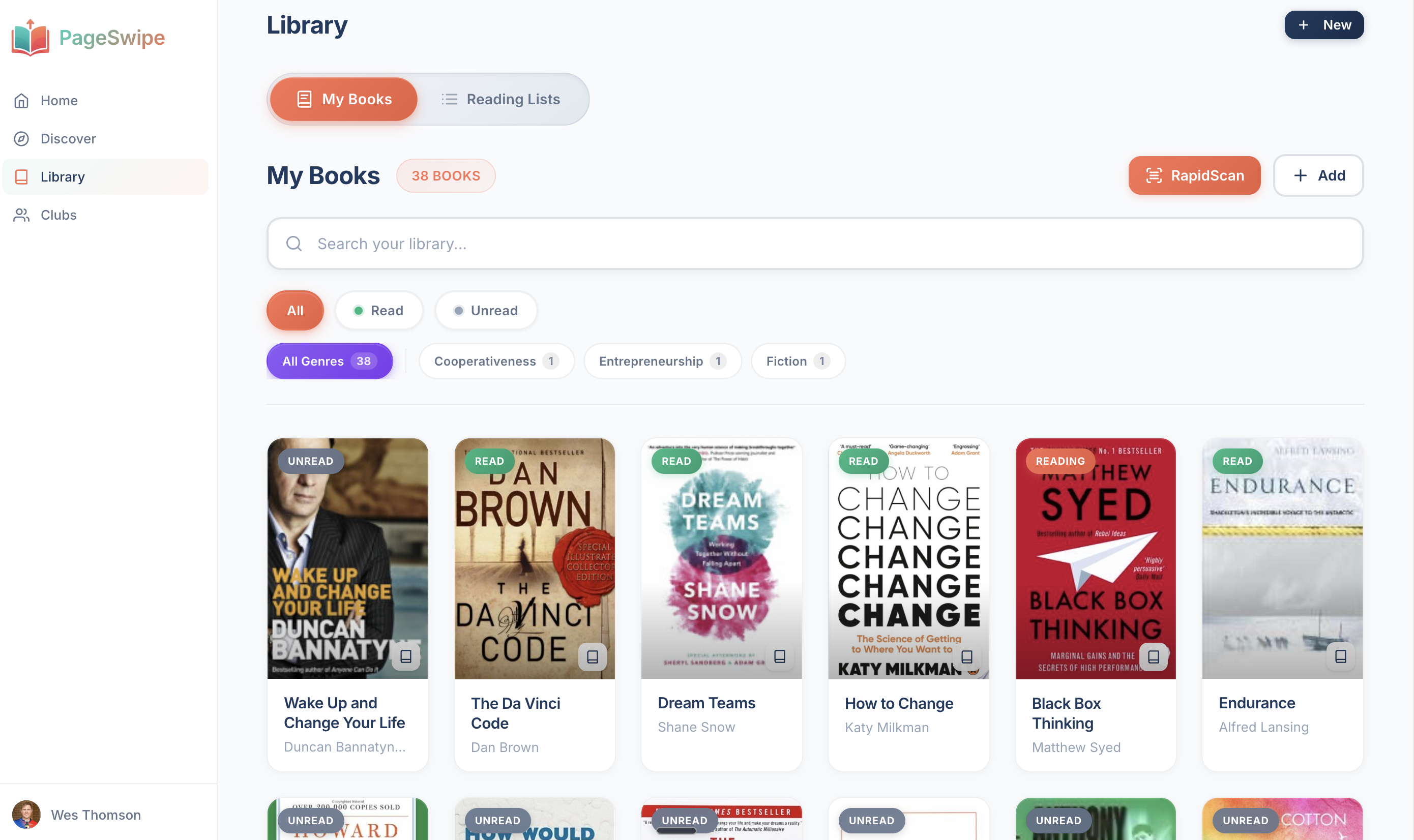
Here is the straight version, because the whole point of this piece is honesty. PageSwipe does not supply readers. It will not put your book in front of a crowd of strangers, and you should be sceptical of anything that claims it can. What it gives your book instead is a home: an official book page — cover, description, ISBN, and your purchase and reading links — and a launch club built around it, with discussion questions you set. You invite your own readers into that club. They read, they talk, and — this is the part that actually travels — they can recommend the book to their own clubs and circles.
So the reach starts with the people you bring: your newsletter subscribers, your friends and family, the early readers you already have. PageSwipe is the place they gather and spread the word onward, not a source of an audience you do not yet have. That is a real, useful job — but it is a different job from "find me readers," and we will not pretend otherwise.
PageSwipe is a free platform for readers and authors: scanning, cataloguing, sharing, lending, clubs, collections, discovery, book pages, and launch clubs are not gated. PageSwipe earns revenue through book-native advertising with authors and publishing houses at scale.
A simple plan for a new author
Nine channels is too many to start with. Here is a sane order of operations that respects everyone's rules and your time.
- Set up your home base. Build one book page you control and create your book's launch page so every other channel has somewhere to point. Add your buy and reading links here.
- Bring your warmest circle in first. Email your list, message friends and early readers, and invite them into the launch club. This is your foundation, not an afterthought.
- Pick two public channels, not eight. Choose the ones where your genre's readers actually gather — say, one subreddit and one Facebook group — and read their rules before you post a single thing.
- Contribute for real. Spend time being a genuine member of those two communities before you ever mention your book, then share only where and when the rules allow.
- Make recommending effortless. Ask your early readers to talk about the book and pass it to their own clubs and circles. Word of mouth from real readers is the channel that compounds.
- Go local. Email one library and one independent bookshop. Offer a talk or a reading. It is slower, but the connections are real.
The pattern underneath every step is the same: earn your place, share where it is welcome, and let real readers carry the book outward. Slower than a mass blast, and the only version that actually works.
Frequently asked questions
Where can I share my book for free?
Plenty of places cost nothing to use: Reddit reader communities, genre forums, Facebook reader groups, your own email newsletter, Goodreads, and BookTok or Bookstagram. Each has its own rules, and many restrict or ban direct self-promotion, so the free part is the account — earning attention still takes genuine participation. You can also create a free book page and launch club on PageSwipe and point your own readers to it.
Can I promote my book on Reddit?
Sometimes, but carefully. Most large reader subreddits, such as r/books, restrict or ban outright self-promotion, and moderators remove posts that break the rules. The safer approach is to become a genuine participant, read each subreddit's rules and wiki, use any designated self-promotion thread or weekly promo day, and only mention your book where it is explicitly allowed. Spamming a link is the fastest way to get removed or banned.
Where can new authors share their books without spamming?
Start with the channels you own or are invited into, where sharing is expected rather than tolerated: your own email newsletter, your own social accounts, and a dedicated book page you can send people to. Then contribute honestly to communities that allow promotion in specific places, following each one's rules. The rule of thumb is simple: share where you have earned a place or been invited, and never drop a link into a space that has asked you not to.
Does PageSwipe find readers for my book?
No. PageSwipe does not supply or manufacture an audience, and no honest tool can. What it gives your book is a home: a shareable book page and a launch club that you point your own readers to. Those readers can then recommend the book to their own clubs and circles. The reach starts with the people you invite; PageSwipe is the place they gather and spread the word, not a source of strangers.
Where should a new author with no audience start?
Begin with the smallest, warmest circle: friends, family, early readers, and anyone who has already shown interest. Give them one clear place to gather around the book, ask them to read and talk about it, and make it easy for them to recommend it onward. A modest group of engaged readers who genuinely spread a book will do more than a link posted into a room full of strangers who never asked for it.
Related reading
If you are working out your wider launch, two companion guides go deeper: how to find readers for your first book walks through the full first-launch playbook, and how to get your book in front of new readers covers reaching people beyond your existing circle. If you also read and run a book club yourself, the PageSwipe book club app is the reader side of the same network. You can see the whole picture at pageswipe.tech.
Give your book a home to share from
Every channel in this guide works better when you have one clean place to point people to — a page that shows the cover, says what the book is, and gives readers somewhere to gather. That home is free to build, and it is the honest starting line: not an audience handed to you, but a place your own readers can rally around and pass onward.
Create your free PageSwipe book page and set up a launch club your readers can join — then start inviting the people who already want to read you.