Home › Blog › How to Inventory Books for Insurance
How to Inventory Books for Insurance
By The PageSwipe Team · 13 May 2026
To inventory books for insurance, make a written record of every book you own — title, author, ISBN, edition, condition, and a value with its source — add cover photos, and store a copy off-site. That document is what lets an insurer replace your collection after a fire, flood, or theft, and what settles an estate fairly. For genuinely rare or valuable books, get a professional appraisal rather than guessing.
TL;DR
- A home contents policy usually covers books, but often with a per-item or category limit a real collection can exceed.
- Record six things per book: title, author, ISBN, edition/printing, condition, and value (with its source).
- Value most books at purchase price or reasonable replacement cost. For rare or signed copies, get a professional appraisal — insurers expect an independent valuation for high-value items.
- Photograph covers, and the copyright page and signature for valuable copies.
- Keep at least one copy of the inventory outside your home and back it up. A list that burns with the shelf helps no one.
- PageSwipe is a free platform for readers and authors: scanning, cataloguing, sharing, lending, clubs, collections, discovery, book pages, and launch clubs are not gated. PageSwipe earns revenue through book-native advertising with authors and publishing houses at scale.
Why a book inventory matters for insurance and estate
Most people never think about their books as insured property until something forces the question — a burst pipe over a bookcase, a house move, a claim, or settling a relative's estate. At that point the problem is always the same: nobody can prove what was there. Insurers do not pay out on "a lot of books." They pay out on records.
A book collection insurance inventory does three practical jobs. First, it establishes that the items existed and belonged to you, which is the first thing any claim has to show. Second, it establishes value, so a loss is settled for a fair amount instead of a token contents figure. Third, it turns a grief-stricken or stressful moment into a paperwork task you already finished — you hand over a file instead of trying to reconstruct decades of buying from memory.
The estate case is quieter but just as real. When a collection passes to family, an inventory that documents book collection value stops a shelf being written off as "a few old paperbacks" when some of it may be worth insuring, keeping, or selling responsibly. It also spares whoever inherits the collection from making valuation decisions with no information at all.
Does home insurance already cover your books?
Usually, yes — as ordinary household contents. The catch is the limits. Many contents policies cap what they pay for any single item, and some group "collections" or "valuables" under a category sub-limit. A shelf of ordinary reading copies rarely troubles those limits. A collection with a few genuinely valuable books can blow straight past them, and the excess simply is not covered unless you have arranged otherwise.
This is why the inventory comes first and the policy conversation comes second. Once you know what you own and roughly what it is worth, you can ask your insurer the only questions that matter: Is my collection covered under the standard contents limit? Do any individual books exceed the per-item cap? Should the valuable ones be scheduled — listed and insured separately — or covered by a valuable-articles rider? None of those questions can be answered without the record. Policies vary widely by insurer and country, so treat this as the shape of the conversation, not specific advice about your cover.
What to record for each book
A good home inventory for books captures enough to identify and replace the exact item, not just something with the same title. Six fields do almost all the work:
- Title and author. The obvious identifier, and enough on its own for common reading copies.
- ISBN. The 13- or 10-digit barcode number. It pins down the exact published version and makes the whole list machine-readable. (Books printed before 1970 predate ISBNs — note the publisher and year instead.)
- Edition or printing. This is where value hides. A first edition, first printing can be worth many times a later reprint of the same title. Record the edition statement and the printing where you can find it.
- Condition. Use plain, honest terms — "as new," "very good," "reading copy, worn spine." Condition drives value for collectible books and sets expectations for a claim.
- Value and its source. Never just a number. Record where the number came from: a purchase receipt, a current retail replacement price, or a professional appraisal. Sourced values are what insurers accept.
- Photos. At minimum the cover. For anything valuable, also photograph the copyright page (which shows edition and printing), the spine, and any signature or inscription.
For most collections you can stop there. Add shelf or room location if you own hundreds of books — it speeds up both finding a title and proving what was in a specific room that flooded.
How to inventory your books, step by step
- Pick one capture method and stick to it. Scanning ISBN barcodes is by far the fastest way to build the list, because it pulls title, author, and edition data automatically instead of you typing every field. A phone camera works; a dedicated cataloguing app that reads barcodes works better at volume.
- Work shelf by shelf. Go left to right, top to bottom, one bookcase at a time, so you never lose your place or double-count. Finishing a shelf before you move gives you a natural progress marker.
- Capture the six fields as you go. Let the scan fill title, author, and ISBN; add condition and value yourself; photograph the cover. Illustratively, a focused hour of scanning can clear several hundred ordinary titles — the manual value and photo work is what takes the time on the rest.
- Flag the maybe-valuable ones. Anything old, signed, a first edition, a fine binding, or simply a book you suspect is worth real money — mark it "appraisal needed" and keep going. Do not stall the whole project trying to value one book.
- Value the ordinary majority yourself. Use purchase price if you have it, or a reasonable current replacement price from a normal retail listing. Ignore the eye-watering asking prices on a handful of rare listings — an asking price is not a market value.
- Get the flagged books appraised. For genuinely collectible items, a qualified rare-book dealer or appraiser gives you an independent valuation. This matters because insurers generally require a professional appraisal to schedule a high-value item, and because you should not be guessing on the books that carry the most risk.
- Store, back up, and date it. Save the finished inventory, put a copy somewhere outside the house, and note the date. Revisit it once a year and after any big purchase.
Estimating value honestly
The single biggest mistake in a book insurance inventory is inventing value — usually upward, by copying the highest price you can find online. Insurers see through it, and an inflated inventory can undermine a legitimate claim. The honest approach is boring and defensible:
- Reading copies: purchase price, or current retail replacement cost. Most of your shelf is here.
- Out-of-print but ordinary: a realistic used-market price, taken from what copies actually sell for, not the highest listing.
- Potentially collectible: leave the value blank and flag it for appraisal. A guessed number here is worse than no number.
To be clear: this article is general guidance, not an appraisal and not financial or insurance advice. For any book you believe is rare, signed, an important first edition, or otherwise valuable, get a professional appraisal from a qualified rare-book dealer or appraiser, and check specific cover questions with your own insurer.
The insurance inventory checklist
Use this as the field list for every book, and the practice list for the inventory as a whole.
| Field / step | Record | Why it matters for a claim |
|---|---|---|
| Title & author | Exact as printed | Primary identifier |
| ISBN | 13- or 10-digit barcode | Pins the exact version; makes the list searchable |
| Edition / printing | e.g. "1st edition, 1st printing" | Often the difference between £15 and a lot more |
| Condition | Plain, honest grade | Drives value; sets claim expectations |
| Value + source | Number and where it came from | Sourced values are what insurers accept |
| Photos | Cover; copyright page & signature if valuable | Proof of existence and condition |
| Location | Room / shelf (large collections) | Proves what was in a specific damaged area |
| Appraisal | For rare / signed / valuable copies | Insurers require independent valuation to schedule |
| Off-site copy | Backup stored outside the home | The record survives the event you're insuring against |
| Date & review | Dated; refreshed yearly | Keeps values and contents current |
Keeping the record safe
An inventory that lives only on the shelf it documents is close to useless. The whole point is that it survives the fire, the flood, or the break-in. Two rules cover it. First, keep the record off-site — in the cloud, in a second physical copy at another address, or both. Second, back it up and be able to export it, so you can hand your insurer or executor a clean, complete file rather than screenshots of an app. A record you cannot get out of the tool it lives in is a record you do not fully control.
Where PageSwipe fits
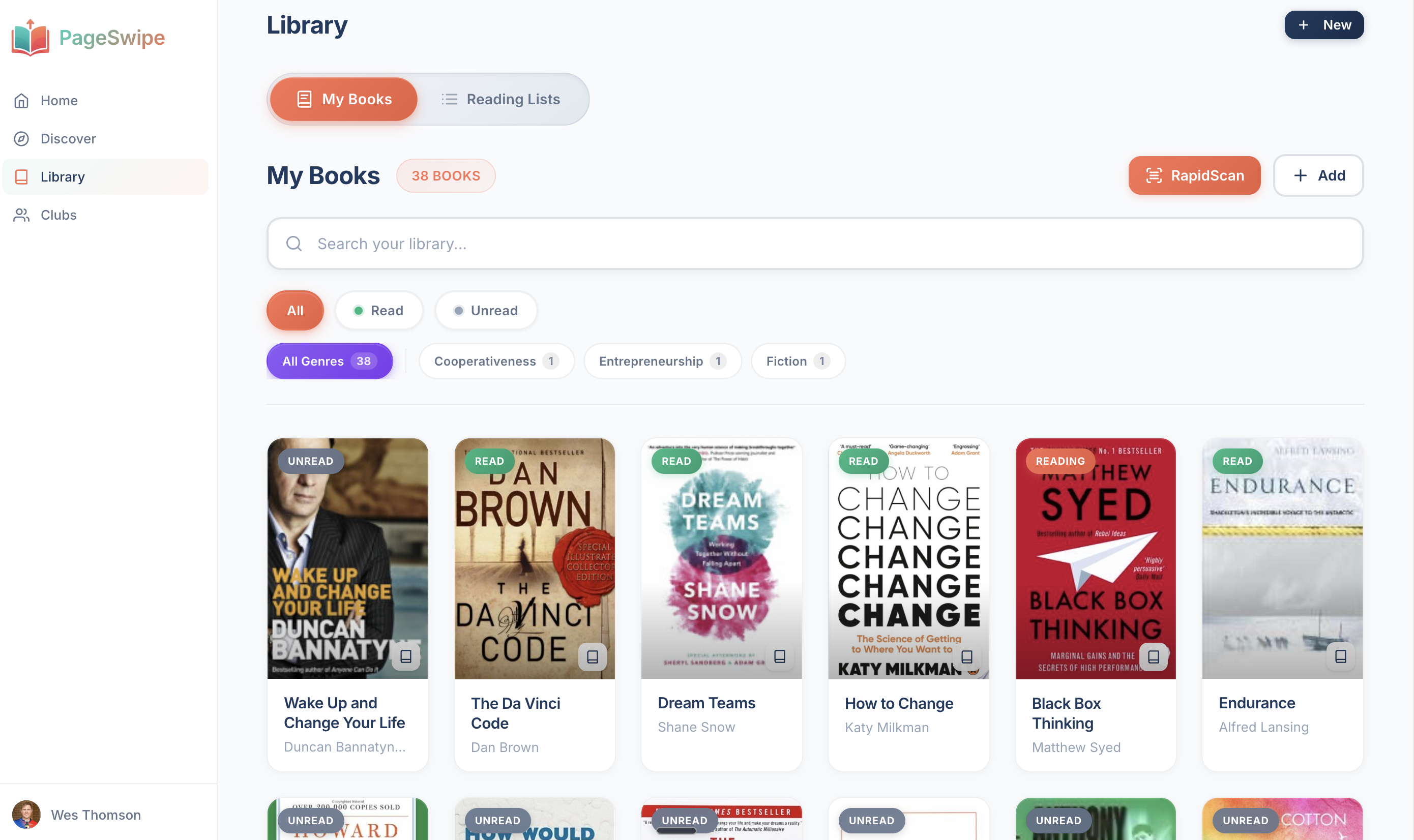
PageSwipe is a connected digital library that starts with your own bookshelf, and it is built for exactly this kind of cataloguing. RapidScan reads ISBN barcodes one after another, so you build a searchable record of everything you own by pointing your phone at spines — the fastest way through the "capture the list" step above. Cataloguing is free and unlimited: there is no cap on how many books you log, so a whole home library goes in without hitting a paywall.
PageSwipe is a free platform for readers and authors: scanning, cataloguing, sharing, lending, clubs, collections, discovery, book pages, and launch clubs are not gated. PageSwipe earns revenue through book-native advertising with authors and publishing houses at scale.
If you want to go deeper on the cataloguing itself, our guide on how to catalog a home library walks through building the list from scratch, and how to organize a large home library covers keeping hundreds of books findable — useful groundwork before you add insurance fields on top. You can also see the fields in one place on the book inventory app page.
Frequently asked questions
Do I need a separate rider to insure my book collection?
A standard home or contents policy usually covers books as ordinary household contents, but often with a per-item or category sub-limit that a valuable collection can exceed. If individual books are worth more than that limit, ask your insurer about scheduling them separately or adding a valuable-articles rider. A written inventory is what those conversations are built on.
How do I estimate the value of my books for insurance?
For most reading copies, record what you paid or a reasonable current replacement cost from a normal retail listing. Do not treat asking prices for rare listings as proof of value. For anything you suspect is genuinely collectible — early printings, signed copies, fine bindings — get a professional appraisal, because insurers want an independent valuation for high-value items.
What details should a book inventory record for insurance?
For each book record the title, author, ISBN, edition or printing, condition, and a value with its source (purchase receipt, replacement cost, or appraisal). Add a photo of the cover and, for valuable copies, the copyright page and any signatures. Keep a copy of the whole inventory somewhere outside your home.
Does PageSwipe help with a book inventory for insurance?
PageSwipe is a free platform for readers and authors: scanning, cataloguing, sharing, lending, clubs, collections, discovery, book pages, and launch clubs are not gated. PageSwipe earns revenue through book-native advertising with authors and publishing houses at scale.
Start with the list
Every insurance and estate decision about your books rests on one thing: a record that actually exists before you need it. Build the catalogue first, add value and photos, get the rare items appraised, and keep a copy off-site. The rest is a conversation with your insurer that you walk into prepared.
PageSwipe is a free platform for readers and authors: scanning, cataloguing, sharing, lending, clubs, collections, discovery, book pages, and launch clubs are not gated. PageSwipe earns revenue through book-native advertising with authors and publishing houses at scale.