Best BookBuddy Alternatives
By The PageSwipe Team · 30 June 2026
BookBuddy is one of the best-loved home-library apps on iOS, and if you are reading this you probably already know why. So before we get to the alternatives, we will be straight about where BookBuddy is genuinely strong — because for a lot of readers it is still the right tool. The rest of this guide is for the people who have hit a specific wall with it: they want something cross-platform, or a library they can actually share, or lending and clubs with real people, not just a private log. This is an honest look at the best BookBuddy alternatives, what each one does well, and where BookBuddy still beats them. PageSwipe is one of the options here, and we will tell you plainly where the others win.
The short answer
There is no single best BookBuddy alternative — the right one depends on the one thing you wish BookBuddy did. Choose Libib if you want the closest like-for-like cataloguing app, with mixed media thrown in. Choose Goodreads if you mainly want reading tracking, reviews and social discovery rather than cataloguing what you own. Choose LibraryThing if you want the deepest catalogue data and a collector community. Choose PageSwipe if you want fast barcode scanning, free unlimited cataloguing on any device, and a connected library you can share, lend and run book clubs from.
TL;DR
- BookBuddy (the incumbent) — mature iOS app, deep per-book detail, custom fields, loan tracker, strong offline control. Still excellent if you live on Apple devices and want a private catalogue.
- Libib — closest cataloguing alternative; also handles films, music and games; free to start.
- Goodreads — best for reading tracking and reviews at scale, not owned-copy cataloguing.
- LibraryThing — best for catalogue depth, tagging and a serious collector community.
- PageSwipe — best for fast RapidScan scanning, free unlimited cataloguing across devices, and a connected library you share, lend and run clubs from.
First, where BookBuddy actually wins
A comparison that only lists a competitor's flaws is not worth much. BookBuddy has earned its reputation, and there are readers who should simply keep using it. Here is what it does better than most of the alternatives below.
- Maturity and polish. BookBuddy has been refined on iOS for years. It is stable, familiar, and does not feel like a work in progress.
- Depth of per-book detail. Custom fields, rich metadata, reading status, ratings and notes — if you like every field filled in, it gives you plenty of knobs.
- A real loan tracker. It has logged who-borrowed-what for a long time, and it does it well for a solo owner.
- Offline, on-device control. Your catalogue lives on your device and works without a connection. For privacy-minded readers, that is a genuine advantage.
If those four points describe what you want, you do not need an alternative — you need BookBuddy. The people who do need an alternative usually want something it was never built to do.
Why people look for a BookBuddy alternative
Across the searches and forum threads, the reasons cluster into four:
- They want cross-platform access. BookBuddy is iOS-focused. In a household with an Android phone, a Windows laptop or a partner on a different device, a single-platform catalogue is hard to share.
- They want a shareable public library page. A private catalogue answers "what do I own?" but not "here is my library, take a look" — a link a friend can open.
- They want to lend and borrow with other people. A private loan log records what you already handed over. It does not let a friend see what is available and ask to borrow it.
- They want book clubs built in. Cataloguing is solitary; many readers want the catalogue to connect to a group — a club that reads together and recommends onward.
Notice the pattern: people rarely leave BookBuddy because cataloguing is bad. They leave when they want the catalogue to stop being private and start being connected. Keep that in mind as you read the options.
How to choose a BookBuddy alternative
Before comparing names, decide which of these jobs matters most. Most people care about two or three, not all of them.
- Platform. Do you need it to work beyond iOS — on Android, in a browser, across a household?
- Speed of entry. How fast can you get hundreds of physical books in? Continuous barcode scanning beats typing by a wide margin.
- Cost and limits. Is there a cap on how many books you can catalogue for free? Read the free tier carefully and check current pricing.
- Sharing and lending. Do you want a private catalogue, a public shelf, or a real way to lend to friends and see what they can lend you?
- Community. Do you want reviews and discovery, a quiet private tool, or a club you run with people you know?
- Import. Do you already have a BookBuddy export, a Goodreads export or a spreadsheet you want to bring across?
Hold each app up against those, and the choice gets simple. Here is how the main options land.
The best BookBuddy alternatives, compared
Libib
Libib is the closest like-for-like alternative to BookBuddy, and the most natural first stop. It is a clean, well-liked cataloguing tool with a strength BookBuddy lacks: it handles books, movies, music and video games in the same library. It offers barcode scanning, a free tier many hobbyist collectors never outgrow, lending features, and the option to publish a library others can browse — plus it works in a browser as well as on mobile, which softens BookBuddy's iOS-only limitation.
Where BookBuddy still wins: depth of per-book detail and a longer-established, more granular solo experience for readers who want every field filled. Where Libib is stronger: mixed-media cataloguing and cross-platform access. Its free and paid tiers differ in features — check current pricing.
Goodreads
Goodreads is the giant, and for good reason: an enormous book database, millions of reviews, reading challenges, and a social feed built around discovery. If your real goal is to track what you read and see what other people think of a book, nothing here matches its scale, and it is free.
Where BookBuddy still wins: cataloguing what you physically own, with detail and a proper loan tracker. Goodreads was not designed to tell you which copies sit on your shelves, where they are, or who borrowed them, and it does not manage lending. Where Goodreads is stronger: reviews, ratings at scale and social reading discovery. Many readers keep a reading tracker and a home library app for exactly this reason.
LibraryThing
LibraryThing is the connoisseur's choice. It offers deep catalogue data, powerful tagging, connections to library catalogues around the world, and a community of serious collectors who care about editions and records. For depth and data quality, it is exceptional, and it works across platforms in a browser.
Where BookBuddy still wins: a cleaner, more modern mobile app that most people find easier day to day. Where LibraryThing is stronger: raw catalogue depth, tag power and its collector community. The trade-off is a busier, more dated interface and a steeper learning curve. Check current pricing.
PageSwipe
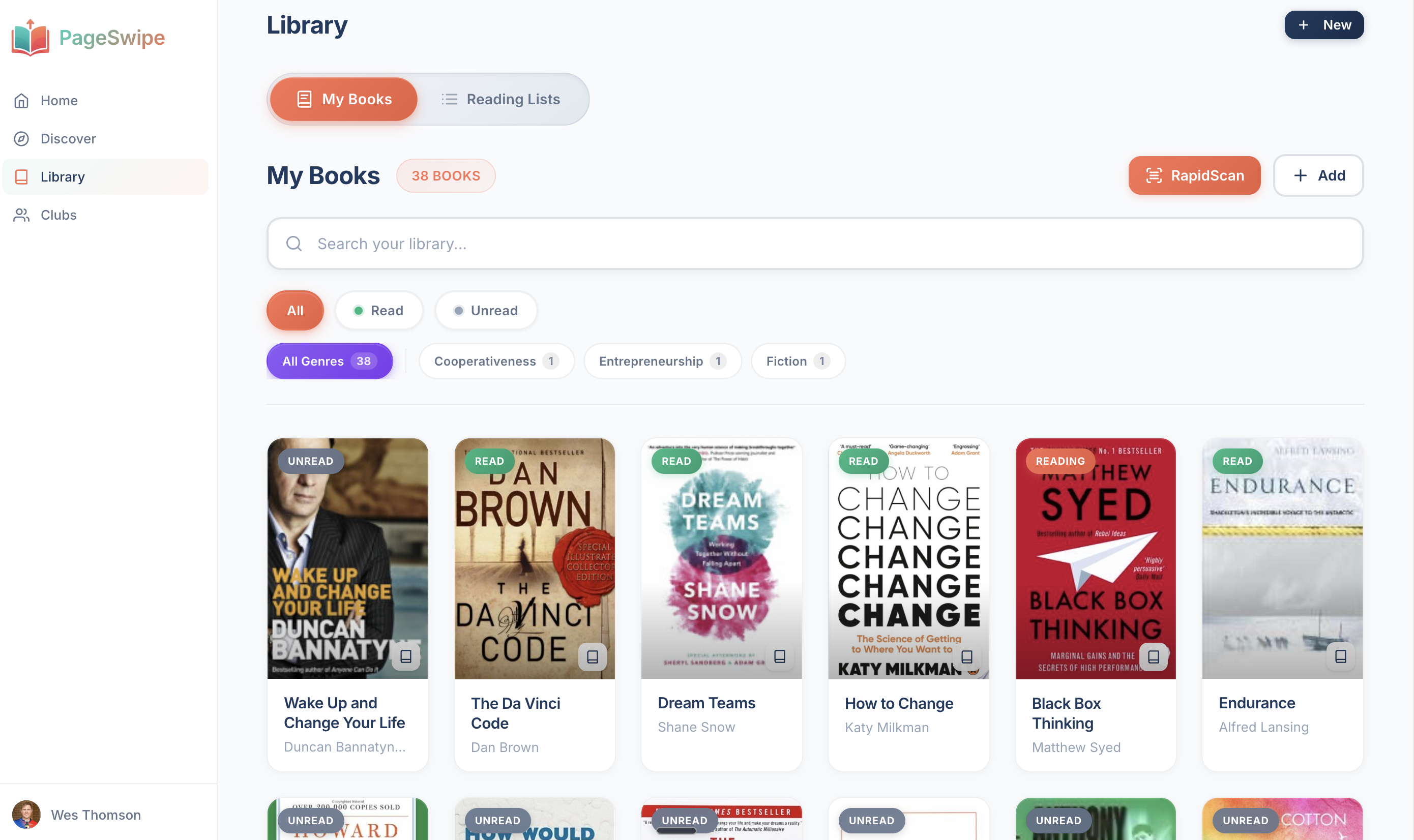
PageSwipe takes a different angle from all of the above. Instead of treating your library as a private database, it treats it as a connected library network — beginning with your own bookshelf. You build the catalogue fast with RapidScan, continuous ISBN barcode scanning, then you can share your library, lend and borrow, and run book clubs with people you trust.
PageSwipe is a free platform for readers and authors: scanning, cataloguing, sharing, lending, clubs, collections, discovery, book pages, and launch clubs are not gated. PageSwipe earns revenue through book-native advertising with authors and publishing houses at scale.
It also answers the four reasons people leave BookBuddy directly: it is not locked to iOS, it gives you a public library page, it lets real people borrow and lend rather than just logging loans, and it has clubs built in.
Where BookBuddy still wins over PageSwipe: it is the more mature app, with deeper per-book custom fields and a fully offline, on-device catalogue. PageSwipe's advantage is not more fields — it is the connection. Not an algorithm recommending strangers' books, but the simple human fact that your friend owns this title, rated it, and can lend it to you. PageSwipe also imports from Goodreads and from spreadsheets, so an existing list — including a BookBuddy export routed through a spreadsheet — comes across without re-scanning.
Comparison table
A quick side-by-side on the dimensions that usually decide it. Feature details and pricing change, so treat this as a starting map and confirm current specifics on each app's own site.
| App | Platform | Scanning speed | Cataloguing limit | Sharing / lending | Clubs |
|---|---|---|---|---|---|
| BookBuddy | iOS-focused | Barcode scanning | Free version + paid (check pricing) | Private loan tracker | No native club feature |
| PageSwipe | Cross-platform | Continuous RapidScan (very fast) | Free, unlimited (no cap) | Public library page + lend/borrow with people you know | Yes — free clubs, unlimited members |
| Libib | Mobile + browser | Barcode scanning | Included in the free reader product | Publish library + lending features | No native club feature |
| Goodreads | Mobile + browser | Scan to add / search | Free | Public profile; no lending management | Groups (reading-focused) |
| LibraryThing | Mobile + browser | Scan + catalogue lookups | Free (check current terms) | Public catalogue; limited lending | Groups (community-focused) |
Illustrative summary only. Pricing and features are set by each app and change over time — always check current pricing and current feature lists before deciding.
So which should you pick?
Match the alternative to the thing BookBuddy could not do for you:
- You want the closest cataloguing app, plus films and music → Libib.
- You mainly track reading and reviews → Goodreads.
- You want the deepest catalogue data and a collector community → LibraryThing.
- You want fast scanning on any device, free unlimited cataloguing, a shareable library, and lending and clubs with people you know → PageSwipe.
- You live on Apple devices and want a deep private catalogue → stay with BookBuddy. It is still very good at that.
Plenty of readers end up using two tools: a reading tracker for what they have read, and a home library app for what they own and lend. There is nothing wrong with that. The point is to stop guessing at your own shelves.
Moving your catalogue across without starting over
The biggest fear in switching is losing the catalogue you already built. You usually do not have to re-enter it. BookBuddy can export your data, and most alternatives accept an import from a spreadsheet or a Goodreads export — so your list travels with you. PageSwipe imports from Goodreads and from spreadsheets directly, which covers most BookBuddy exports once they are in a sheet.
The other half of switching is lending. If the reason you are leaving is that you want other people to see and borrow your books, it is worth reading how a connected loan actually works — our guide to tracking borrowed books walks through the difference between a private loan log and a shared borrow request. And if you want a tool built around scanning-first cataloguing you can share, that is exactly what the PageSwipe home library app is for.
Related reading
If you are weighing up cataloguing apps more broadly, two companion guides go deeper on the wider field: our roundup of the best Libib alternatives covers the other cataloguing-first tool most people compare against, and our guide to the best book tracking apps maps the full landscape of tracking, cataloguing and reading apps side by side. You can also read more about the connected-library approach at pageswipe.tech.
Frequently asked questions
What is the best alternative to BookBuddy?
There is no single best alternative for everyone. Libib is the closest like-for-like cataloguing app and adds mixed media. Goodreads is best if you mainly want reading tracking and reviews. LibraryThing is best for catalogue depth. PageSwipe is the best fit if you want fast barcode scanning, free unlimited cataloguing across any device, and a connected library you can share, lend and run clubs from.
Why do people look for a BookBuddy alternative?
The most common reasons are wanting something beyond iOS so a household can use it on any device, wanting a shareable public library page, wanting to lend and borrow with other people rather than just log loans privately, and wanting book clubs built in. BookBuddy is a strong solo iOS cataloguing app; people leave when they need cross-platform access or a connected network.
Is there a free alternative to BookBuddy?
Yes. Libib and PageSwipe both offer free cataloguing. PageSwipe includes unlimited book cataloguing at no cost, with no per-book cap, plus free sharing, lending and clubs. Free and paid tiers differ between apps and change over time, so check current pricing before you commit.
What does BookBuddy do better than the alternatives?
BookBuddy is a mature, polished iOS app with deep per-book detail, custom fields, a built-in loan tracker and strong offline, on-device control. If you live entirely on Apple devices and want a granular private catalogue you can use without a connection, BookBuddy is genuinely excellent and hard to beat on those points.
Can I move my books from BookBuddy to another app?
Often, yes. BookBuddy can export your data, and many apps accept an import from a spreadsheet or a Goodreads export. PageSwipe imports from Goodreads and from spreadsheets, so you can bring an existing list across rather than re-scanning everything. Check each app's current import options, as they differ.
Start with your own shelf
The best BookBuddy alternative is the one that does the specific thing BookBuddy could not do for you — and the quickest way to judge it is to catalogue a single shelf and see how it feels. If what you were missing was speed, cross-device access, and a library other people can actually see and borrow from, that is worth ten minutes of your time to test.
Scan your first book with RapidScan and watch your shelf become a searchable, shareable, connected library — free, and with no cap on how many books you add.