Best Libib Alternatives: 6 Honest Picks
By The PageSwipe Team · 26 June 2026
Libib is a genuinely good app, so if you are looking for an alternative you probably have a specific reason — you want more sharing and lending, a book club, a library that feels connected to other people rather than sealed in a private database, or simply a different scanning flow on your phone. This is an honest look at the best Libib alternatives, what each one is genuinely good at, and — just as important — where Libib still beats every option on this list. PageSwipe is one of the alternatives here, and we will tell you plainly where it is not the right choice.
The short answer
The best Libib alternative depends on the job you care about most — there is no single winner. Choose BookBuddy if you are on iOS and want deep, detailed records for every copy. Choose Goodreads if reading and reviewing matters more to you than cataloguing what you own. Choose LibraryThing if you want the deepest catalogue data and a community of serious collectors. Choose PageSwipe if you want fast barcode scanning, free unlimited cataloguing with no per-book cap, and a connected library you can share, lend and run clubs from with people you actually know. And if your collection includes films, music and games as well as books, the honest answer may be to stay on Libib — more on that below.
TL;DR
- Libib (the incumbent) — best for mixed media (books, movies, music, games); established, clean, free to start.
- BookBuddy — best for iOS users who want rich per-book detail and loan tracking.
- Goodreads — best for reading tracking, reviews and social discovery, not owned-copy cataloguing.
- LibraryThing — best for catalogue depth, tagging and connections to world libraries.
- PageSwipe — best for fast RapidScan scanning, free unlimited cataloguing, and a connected library you share, lend and run clubs from.
- A spreadsheet — best if you want total control and near-zero features; worst for scanning and lending.
First, an honest word about Libib
It is worth being clear about what you would be leaving. Libib is well-liked for good reasons. Its standout strength is that it catalogues books, movies, music and video games in the same place — a genuinely useful trick that most book apps cannot do. It is established and mature, with a clean web and mobile experience, barcode scanning, a free tier that many hobbyist collectors never outgrow, lending features, and the option to publish a library that others can browse.
So the question is not "what is wrong with Libib" — usually nothing is. The question is whether the job you now care about is one Libib was built for. If you want your Blu-rays and vinyl in the same catalogue as your paperbacks, no alternative below will serve you better, and you should probably stay. If you want a books-first tool that leans into sharing, lending and clubs, read on.
Why people look for a Libib alternative
Before comparing names, name the reason you are here. Most people who move want one of these:
- Sharing, lending and clubs. You want your library to be social — friends who can see what is on your shelves, ask to borrow, and read together — not just a private list you keep for yourself.
- A connected library, not a database. You want the human layer: your friend owns this title, rated it, and can lend it — rather than a solo catalogue that never talks to anyone else's.
- A specific mobile scanning flow. You catalogue on your phone, down a shelf, and you want continuous scanning that keeps pace with you.
- Books-first, not mixed media. You only catalogue books and would rather the whole app be built around them.
- Cost and limits. You want cataloguing that stays free as your shelves grow, with no cap to bump into.
Hold each app up against your reason, and the choice gets simple. Here is how the main alternatives land.
The best Libib alternatives, compared
BookBuddy
BookBuddy is a long-standing favourite on iOS for readers who want detail. You can record rich metadata for every copy, add custom fields, track loans, mark reading status, and export your data. For someone who treats a catalogue like a card index and wants every field filled in, BookBuddy is thorough and polished — a natural move from Libib if what you want is more depth per book.
Where BookBuddy beats Libib: depth of per-book detail, custom fields, and a mature loan tracker for lending to friends. Where it does not: it is iOS-focused, so it is less useful across a mixed-device household, and it does not catalogue mixed media the way Libib does. Check current pricing for its full-feature version. If BookBuddy is on your shortlist, our guide to the best BookBuddy alternatives is worth a look too.
Goodreads
Goodreads is the giant, and for good reason: an enormous book database, millions of reviews, reading challenges, and a social feed built around discovery. If your real goal is to track what you read and see what friends and strangers think of a book, nothing here matches its scale.
Where Goodreads beats Libib: reviews, ratings at scale, and social reading discovery. Where it does not: that is a different job from cataloguing what sits on your shelves. Goodreads was not designed to tell you which physical copies you own, where they are, or who borrowed them, and it does not manage lending. Many readers keep a reading tracker and a home library app for exactly this reason — see our roundup of the best book tracking apps if reading progress is your priority.
LibraryThing
LibraryThing is the connoisseur's choice. It offers deep catalogue data, powerful tagging, connections to library catalogues around the world, and a community of serious collectors and cataloguers who genuinely care about editions and records. For depth and data quality, it is exceptional, and a natural home for anyone who found Libib's records too light.
Where LibraryThing beats Libib: raw catalogue depth, tag power, and its collector community. Where it does not: the interface is busier and more dated, and the learning curve is steeper — the price of all that capability. Check current pricing for its plan.
PageSwipe
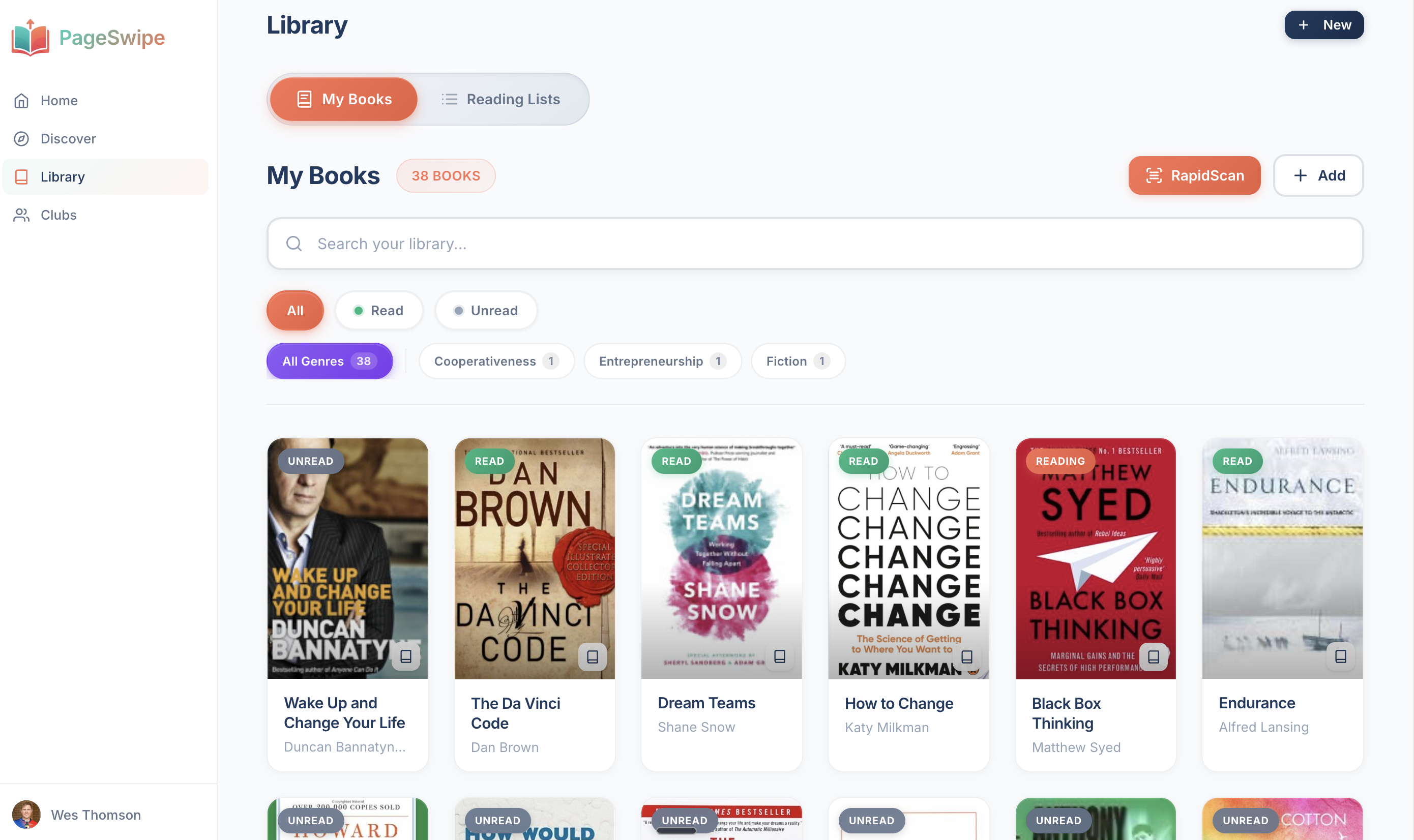
PageSwipe takes a different angle from Libib. Instead of treating your library as a private catalogue, it treats it as a connected library network — beginning with your own bookshelf. You build the catalogue fast with RapidScan, continuous ISBN barcode scanning, then you can share your library, lend and borrow, and run book clubs with people you trust.
PageSwipe is a free platform for readers and authors: scanning, cataloguing, sharing, lending, clubs, collections, discovery, book pages, and launch clubs are not gated. PageSwipe earns revenue through book-native advertising with authors and publishing houses at scale.
Where PageSwipe beats Libib: the connected layer. Not an algorithm recommending strangers' books, but the simple, human fact that your friend owns this title, rated it, and can lend it to you — plus free clubs and unlimited free cataloguing. Where it does not: PageSwipe is built for books, so if you want films, music and games in one catalogue, Libib remains the better home. PageSwipe imports from Goodreads and from spreadsheets, so an existing list — including a Libib export you save as a spreadsheet — comes across without re-scanning.
A spreadsheet
It is worth naming the option many people fall back to: a plain spreadsheet. It is free, endlessly flexible, and yours forever. Where it beats every app: total control and zero lock-in. Where it loses badly: no barcode scanning, no lending workflow, no sharing beyond sending a file, and hours of typing to get books in. If you already have one, the better move is usually to import it into an app rather than keep maintaining it by hand.
Comparison table
A quick side-by-side on the dimensions that usually decide it. Feature details and pricing change, so treat this as a starting map and confirm current specifics on each app's own site.
| App | Scanning speed | Cataloguing limit | Sharing / lending | Clubs | Mixed media |
|---|---|---|---|---|---|
| Libib | Barcode scanning | Included in the free reader product | Publish library + lending features | No native club feature | Yes — books, film, music, games |
| PageSwipe | Continuous RapidScan (very fast) | Free, unlimited (no cap) | Share library + lend/borrow with people you know | Yes — free clubs, unlimited members | Books-first (no) |
| BookBuddy | Barcode scanning (iOS) | Free version + paid (check pricing) | Loan tracker | No native club feature | Books-focused |
| Goodreads | Scan to add / search | Free | Public profile; no lending management | Groups (reading-focused) | Books-focused |
| LibraryThing | Scan + catalogue lookups | Free (check current terms) | Public catalogue; limited lending | Groups (community-focused) | Books-focused |
Illustrative summary only. Pricing and features are set by each app and change over time — always check current pricing and current feature lists before deciding.
So which Libib alternative should you pick?
Match the app to the reason you are leaving, not the other way round:
- You own more than books (films, music, games) → stay on Libib. Nothing here does mixed media better.
- You want maximum per-book detail on iOS → BookBuddy.
- You mainly track reading and reviews → Goodreads.
- You want the deepest catalogue data and a collector community → LibraryThing.
- You want fast scanning, free unlimited cataloguing, and a library you share, lend and run clubs from → PageSwipe.
Plenty of readers end up using two tools: a reading tracker for what they have read, and a home library app for what they own and lend. There is nothing wrong with that. The point is to pick for the job you actually care about.
Moving your catalogue across without re-scanning
Whatever you choose, the migration is the part people dread — and it is usually easier than expected. Libib can export your data, and most alternatives can import from a spreadsheet or an export file. The practical order is simple: export from Libib, tidy the columns, then import into your new app, and only scan the handful of books that did not carry across cleanly.
If the tool you land on is built around scanning-first entry and sharing with people you know, that is exactly what the PageSwipe home library app is for — free unlimited cataloguing, RapidScan, and a connected library you can lend from. You can read more about the wider approach at pageswipe.tech.
Frequently asked questions
What is the best alternative to Libib?
It depends on the job you care about. BookBuddy is a strong alternative for iOS users who want deep per-book detail, Goodreads is best for reading and reviews, and LibraryThing is best for catalogue depth. PageSwipe is the best fit if you want fast barcode scanning, free unlimited cataloguing with no per-book cap, and a connected library you can share, lend and run clubs from with people you know.
Why do people look for a Libib alternative?
Libib is a well-liked cataloguing app, so most people leave for a specific reason rather than a fault. Common reasons are wanting more sharing, lending and book clubs, a more social and connected library rather than a private database, or a particular mobile scanning flow. Some also want a books-first tool rather than a mixed-media catalogue.
Is Libib free, and are the alternatives free too?
PageSwipe is a free platform for readers and authors: scanning, cataloguing, sharing, lending, clubs, collections, discovery, book pages, and launch clubs are not gated. PageSwipe earns revenue through book-native advertising with authors and publishing houses at scale.
Where does Libib still beat the alternatives?
Libib's biggest strength is cataloguing mixed media — books, movies, music and video games in one library. If your collection is more than just books, Libib is hard to beat. It is also established, with a mature web and mobile experience and a free tier that suits many hobbyist collectors.
Can I move my Libib catalogue to another app?
Usually yes. Libib supports exporting your data, and most alternatives support import from a spreadsheet or export file. PageSwipe imports from Goodreads and from spreadsheets, so you can bring an existing list across rather than re-scanning every shelf. Check each app's current import and export options, as they differ.
Start with your own shelf
The best Libib alternative is the one you will actually fill — which means the one that makes entry fast, keeps cataloguing free as your shelves grow, and does the job you left Libib to do. The quickest way to judge it is to catalogue a single shelf and see how it feels.
Scan your first book with RapidScan and watch your shelf become a searchable, shareable library — free, and with no cap on how many books you add.