Goodreads Alternatives for Book Clubs
By The PageSwipe Team · 18 June 2026
Goodreads can run a book club, but few clubs love how it feels. The group tools are dated, there is no built-in way to schedule a meeting or run a proper vote, and nothing tells you who in the group actually owns a copy of this month's pick. If you have been searching for Goodreads alternatives for book clubs, this is an honest look at the tools worth considering — what each one is genuinely good at, and where each will serve your club better than the others. PageSwipe is one of the options here, and we will tell you plainly where the alternatives win.
The short answer
There is no single best app for every book club — the right one depends on what your club struggles with most. Choose Bookclubs if scheduling meetings and running polls is your biggest pain. Choose Fable if you want reading and discussion to happen inside one hosted app. Choose StoryGraph if buddy reads and reading data matter most. Choose Discord if your club lives on ongoing, informal chat. Choose PageSwipe if you also want a shared, real record of the books members own — so the club can browse each other's shelves, recommend titles, vote on the next read, and lend copies within the group instead of everyone buying the same book.
TL;DR
- Bookclubs (Bookclubs.com) — best for meeting scheduling, availability polls and club organising.
- Fable — best for hosted in-app reading with discussion built around the text.
- StoryGraph — best for buddy reads, reading stats and mood-based recommendations.
- Discord — best for lively, always-on chat and larger online communities.
- Goodreads groups — best for the book database and simple threaded discussion, weakest on organising.
- PageSwipe — best for a connected club: shared shelves of books members own, free voting on the next read, recommendations, and lending within the club.
What a book club actually needs from an app
Before comparing names, it helps to name the jobs. A book club is not one need — it is five or six, and most clubs care deeply about two or three of them. Score each tool against these and the choice gets simple.
- A shared shelf. One place everyone can see the current pick, past reads, and what is coming up.
- Choosing the next read. A way to nominate candidates and vote, so the decision is not one person's guess or a chaotic group chat.
- Discussion. Somewhere to talk about the book — threaded, chronological, or question-led.
- Scheduling. Setting a meeting date and time that works for the group, and reminding people.
- Member libraries. Knowing who owns a copy — so members can borrow from each other instead of everyone buying the same title.
- Cost. Whether the club can do the basics for free, or hits a paywall to create or run the group.
No tool nails all six. That is the honest starting point. Here is how the main Goodreads alternatives land.
The best Goodreads alternatives for book clubs, compared
Bookclubs (Bookclubs.com)
Bookclubs is the tool most purpose-built for the organising side of a club. It handles meeting scheduling, availability polls to find a date, RSVPs, book voting, reminders, and a shared record of what the group has read. If your club's real friction is "we can never agree on when to meet" or "nobody remembers what we picked," this is the category leader.
Where Bookclubs is stronger than PageSwipe: dedicated meeting scheduling and RSVP management. PageSwipe has voting and a club home, but it is not a calendar-and-availability tool — if the logistics of getting people in a room on the right night is your main headache, Bookclubs is the more focused choice. Check its current free and paid tiers before you commit.
Fable
Fable takes a hosted approach: readers can read certain titles inside the app and discuss them alongside the text, with folios, prompts and a polished social layer. For clubs that want the whole experience — reading and talking — to live in one place, and that enjoy a curated, community feel, Fable is genuinely pleasant.
Where Fable is stronger than PageSwipe: in-app reading and discussion woven around the book itself, plus a strong hosted community experience. PageSwipe does not host the reading experience — it is built around the physical books members own. If your club wants to read and discuss inside a single app, Fable is closer to that. Check current pricing, as some features sit behind a paid tier.
StoryGraph
StoryGraph has earned a devoted following as a Goodreads alternative, and its buddy reads feature is well suited to small groups reading the same book in step. Add its mood- and pace-based recommendations, detailed reading stats, and clean interface, and it is a strong home for readers who care about the data behind their reading.
Where StoryGraph is stronger than PageSwipe: reading analytics, mood-based recommendations, and buddy reads for reading a book together at a shared pace. That is a different job from cataloguing owned copies and lending them. StoryGraph offers a free plan and a paid tier — check current pricing.
Discord
Plenty of book clubs, especially larger online ones, simply live on Discord. It is free, endlessly flexible, and unbeatable for ongoing, informal conversation — channels for the current read, spoiler zones, voice chats for meetings, and bots for polls if you want them. For a chatty, always-on community, little else feels as alive.
Where Discord is stronger than PageSwipe: real-time chat, voice, and the sheer flexibility of a general community platform. The trade-off is that Discord knows nothing about books — no book database, no shared shelf, no record of who owns what — so you assemble the club experience yourself out of channels and bots.
Goodreads groups
It is worth being fair to the incumbent. Goodreads groups give you threaded discussion attached to the largest book database and review corpus anywhere, which is a real advantage when you want to look up a title, read reviews, and talk about it in one ecosystem.
Where Goodreads is stronger than PageSwipe: the depth of its book database and the volume of existing reviews and ratings. The weak points are the ones that send clubs looking for alternatives: dated group tools, no native meeting scheduling or availability polls, and no way to see which physical copies members own or can lend.
PageSwipe
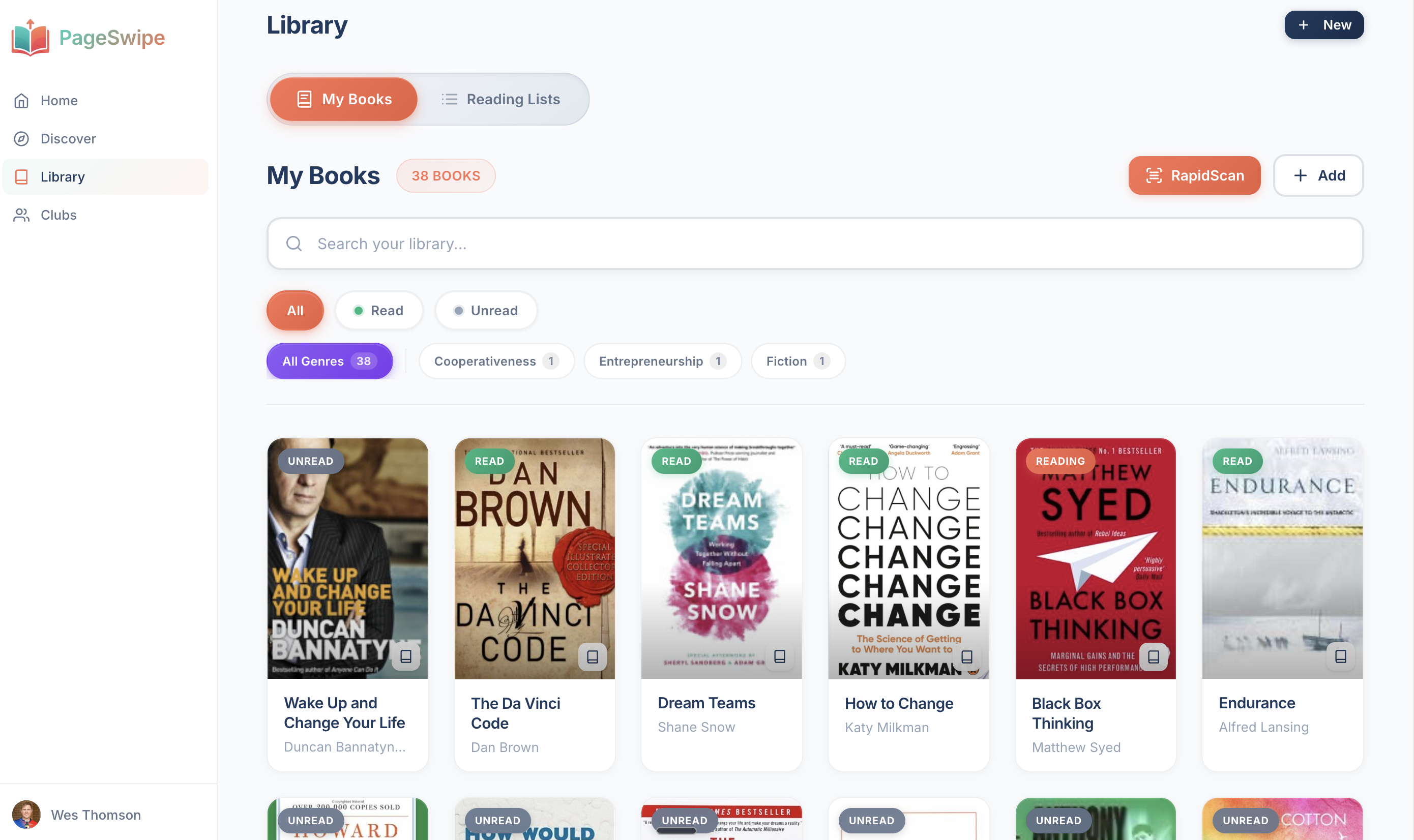
PageSwipe comes at the book club from a different angle. Instead of treating the club as a chat room with a book attached, it treats your club as a connected library — a group of people whose real, physical shelves are visible to each other. You build your own catalogue fast with RapidScan, continuous ISBN barcode scanning, then create a club, invite people, and the group can see what everyone owns.
That unlocks the things other tools miss. The club can browse members' owned books, recommend titles to each other, and vote on the next read — the shortlist and the result living in the same place as the club. And because PageSwipe knows who owns which copy, a member can send an Ask to borrow request and lend within the club, so a group of six does not have to buy six copies of the same book. The differentiator is not an algorithm suggesting strangers' books; it is the simple, human fact that someone in your club owns this title, rated it, and can lend it to you.
PageSwipe is a free platform for readers and authors: scanning, cataloguing, sharing, lending, clubs, collections, discovery, book pages, and launch clubs are not gated. PageSwipe earns revenue through book-native advertising with authors and publishing houses at scale.
Where PageSwipe is honest about its limits: it does not host the reading experience the way Fable does, it is not a dedicated availability-and-RSVP scheduler the way Bookclubs is, and it is not a real-time chat platform the way Discord is. What it uniquely gives a club is the shared record of what members actually own, and the ability to lend it around.
Comparison table
A quick side-by-side on the dimensions that usually decide it for a club. Features and pricing are set by each tool and change over time, so treat this as a starting map and confirm current specifics on each app's own site.
| Tool | Shared shelf | Vote on next read | Discussion | Scheduling | Member libraries / lending |
|---|---|---|---|---|---|
| PageSwipe | Yes — members' owned books | Yes — built in, free | Club recommendations + discussion | Included in the free reader product | Yes — browse + Ask to borrow within the club |
| Bookclubs | Yes — reading history | Yes — book polls | Discussion threads | Yes — meeting scheduling + RSVPs | No owned-copy lending |
| Fable | Yes — in-app folios | Varies by club setup | In-app, around the text | Limited | No owned-copy lending |
| StoryGraph | Buddy read shelves | Polls / buddy reads | Buddy read comments | No native scheduling | No owned-copy lending |
| Discord | No native shelf | Via bots | Excellent — channels + voice | Via bots / events | No owned-copy lending |
| Goodreads groups | Group bookshelves | No native poll | Threaded discussion | No native scheduling | No owned-copy lending |
Illustrative summary only. Pricing and features are set by each tool and change over time — always check current pricing and current feature lists before deciding.
So which should your club pick?
Match the tool to the job your club struggles with most:
- You can never agree on a date → Bookclubs for scheduling and RSVPs.
- You want reading and discussion in one hosted app → Fable.
- You love reading data and reading in step → StoryGraph buddy reads.
- Your club is chatty and lives online → Discord.
- You want the biggest book database with simple threads → Goodreads groups.
- You want a shared shelf of what members own, free voting, and lending within the club → PageSwipe.
Many clubs happily use two tools: one for discussion or scheduling, and one for the shared record of what everyone owns. There is nothing wrong with that. The point is to stop running your club out of a group chat and a spreadsheet.
Getting your club set up without the overwhelm
Whatever you choose, the first practical step is the same — getting members' books into a shared place so the group can see what it has to work with. That is where scanning beats typing by a wide margin: point the camera at a barcode and the ISBN is in. If you are weighing the wider field of Goodreads replacements, our guide to the best Goodreads alternatives covers the reading-and-tracking side, and if your members care about what they read as much as what they own, the best book tracking apps guide compares those directly.
If you want a tool built around clubs whose members can actually see and lend each other's books, that is exactly what the PageSwipe book club app is for. You can also read more about the wider connected-library approach at pageswipe.tech.
Frequently asked questions
What is the best app for a book club?
There is no single best app for every club. Bookclubs is strongest for scheduling meetings and running polls, Fable is best for hosted in-app reading and discussion, StoryGraph is best for buddy reads and reading data, and Discord is best for lively ongoing chat. PageSwipe is the best fit if your club also wants a shared, real record of the physical books members own and can lend to each other, plus free voting on the next read.
Is Goodreads good for book clubs?
Goodreads groups can work for a book club, with discussion threads and a huge book database attached. The weak points are dated group tools, no built-in meeting scheduling or polls, and no way to see which physical copies members actually own or can lend. Many clubs use Goodreads for the book data and a second tool for organising.
What is a free alternative to Goodreads for book clubs?
Several tools have free tiers. Bookclubs and StoryGraph both offer free plans, and Discord is free to use. PageSwipe lets you create a club, invite unlimited members, browse the books members own, recommend titles and vote on the next read at no cost, with no paid gate on creating the club itself.
How does a book club vote on the next book to read?
The simplest method is a shortlist plus a vote. Members nominate two to five candidates, then everyone votes and the highest score wins. Bookclubs and StoryGraph include polling features, and PageSwipe has built-in voting on the next club read, so the shortlist and the result live in the same place as the club.
Can book club members share or lend books to each other?
Most reading and discussion apps do not track who physically owns a copy. PageSwipe is built around this: members catalogue the books they own by scanning them, the club can browse those shelves, and a member can send an Ask to borrow request to lend a copy within the club rather than everyone buying the same title.
Start with your own shelf
The best book club app is the one your members will actually use — which usually means the one that makes it easy to see what the group already owns and to choose the next read together without a fight. If that sounds like what your club needs, the quickest way to judge it is to catalogue a single shelf and see how it feels.
Scan your first book with RapidScan and turn your shelf — and your club's — into a shared, searchable library you can vote from and lend within, free, with no cap on how many books you add.