How to Get Readers to Recommend Your Book
By The PageSwipe Team · 9 August 2026
Ask almost any author how they found the last book they loved and the answer is rarely an advertisement. It is usually a friend, a colleague, a book club — someone whose taste they trust. Word of mouth is the oldest engine in publishing and still the strongest. The hard part is that you cannot buy or force it. What you can do is make your book genuinely easy to recommend, and ask for that recommendation when a reader is most willing to give it — honestly, without pretending recommendations appear on their own.
The short answer
To get readers to recommend your book, make it effortless to pass on and ask at the right moment. Give every reader a one-line hook they can repeat, a single page they can share instead of describing the book from memory, and discussion questions that turn a solo read into a conversation. Then ask when they have just finished and are still enthusiastic, for one small thing — tell a friend, share the page, join the club. You remove friction; the reader does the recommending. No tool manufactures word of mouth, but the right setup lets a willing reader act instead of forgetting.
TL;DR
- Word of mouth wins because a book is a trust purchase. A personal recommendation beats any ad, and it compounds over time.
- Make the book easy to recommend: a clear hook, a shareable page, discussion questions, and a book-club-friendly format.
- Ask at the right moments — the moment a reader finishes, not before they have read a word.
- Make readers feel part of it, not marketed at. People spread what they feel ownership of.
- Keep reviews honest. Never pay for positive reviews or run rating swaps — it breaks trust and platform rules.
- PageSwipe does not supply readers. It gives your book a home where the readers you invite can gather and recommend it onward.
Why word of mouth is the strongest engine a book has
A book asks a lot of a person: money, but more than that, hours. Choosing one is a high-trust decision, and high-trust decisions are made on recommendation, not persuasion. When a friend says "read this, it is worth your time," they are spending their own credibility on your behalf. No advertisement can do that.
Two properties make word of mouth worth more than almost anything else you can do:
- It compounds. One reader who loves the book tells two; each tells more. A quiet chain keeps finding readers long after any launch has gone silent — advertising stops when you stop paying; a recommendation keeps working.
- It travels between trusted circles. A recommendation crosses from one group of friends to another — a reader to their book club, that club to a member's colleague. Each hop lands inside a relationship that already has trust, which is why it converts far better than a cold ad.
The catch is honesty: you cannot fabricate this. Bought recommendations poison the well. The job is not to invent recommendations — it is to earn them with a good book and make them easy to give.
Make your book genuinely easy to recommend
Most books that could be recommended never are, because it is a small hassle. The reader loved it, meant to mention it, could not remember the title, did not know where to point a friend — and the moment passed. Your task is to remove those obstacles.
1. Give readers a hook they can actually repeat
When someone recommends your book out loud, they will not recite your blurb — they will use one sentence. If you have not written that sentence, they improvise a worse one, or say nothing. So write it for them: short, concrete, and curious enough to say across a dinner table without sounding like an advertisement. Compare "it's a novel about family and memory" with "it's about a woman who finds her late mother's diary and realises none of it is true." The second travels because it can be repeated word for word. Put your hook where readers absorb it: the back cover, the first line of your book page, the note after someone finishes.
2. Give them a single page they can share
The most common failure point in word of mouth is the handoff — the reader wants to recommend the book but has nowhere clean to send their friend. "It's on Amazon, I think, search the title" is friction, and friction kills recommendations. What a reader needs is one link — cover, short description, where to buy or borrow it — that does the explaining.
This is what a dedicated book page is for: instead of reconstructing your book from memory, a reader pastes one URL with a single line — "read this." The easier that handoff, the more often it happens.
3. Add discussion questions that start conversations
A book that gets talked about gets recommended, and nothing prompts talk like a good question. A handful of discussion questions turns a solitary read into something a group can chew on — and every group conversation is a recommendation engine, because members bring the book to others' attention by discussing it.
4. Make the book book-club-friendly
Book clubs are word-of-mouth machines: one choice puts your book in front of a whole group at once, and members carry it outward. You can make your book the easy pick without changing a word of it:
- Provide a ready-made club kit — the discussion questions above, an author note, and a one-paragraph summary a host can send round.
- Offer to appear. Many authors will join a club call for twenty minutes. For a group of ten, that is ten new advocates and often their friends after.
- Keep it accessible in the formats members use.
Ask at the right moments
Even a recommendable book needs a nudge, because readers are busy and forget. The skill is when and how you ask — get either wrong and it reads as needy.
- Ask the instant they finish. The peak of enthusiasm is the final page — a line at the back of the book, or a note a day or two after a reader marks it finished. Ask before they have read it and you are asking a favour; ask at the end and you are riding real feeling.
- Ask for one specific thing. "Please spread the word" is too vague to act on. "Tell one person who would love it" or "share the book page" gives the reader a single, doable task.
- Ask once, warmly, and then stop. A single sincere request lands. Repeated nagging turns advocates into people who mute you.
- Ask where readers already gather. A prompt at the end of a book-club discussion reaches people while they are already talking about books.
Make readers feel part of it
People recommend what they feel some ownership of. A reader who feels part of a book's story — who got in early, talked to the author, watched a club form around it — recommends it as theirs, not as a product they were sold. That feeling cannot be faked, but it can be invited: thank early readers by name, answer their messages, let a club vote on your next book. When readers feel seen, they become genuine advocates — the honest heart of word of mouth is relationship, not tactics.
Keep honest reviews honest
Reviews are a public form of recommendation, and they matter — but only if they are real. The line is bright: ask real readers for honest reviews, and never do anything to manufacture positive ones.
Do: ask directly and point readers to where a review helps, telling them their honest opinion — good or bad — is what you want; ask at the finish line while the book is fresh; and welcome critical reviews, because a mix of honest ratings reads as trustworthy where a wall of five stars looks staged.
Never: pay for positive reviews or offer rewards tied to a rating; run review swaps ("I'll five-star yours if you five-star mine"); or post reviews under fake identities.
These practices break most retailer policies, mislead the readers you are trying to earn, and can get a book removed. Beyond the rules, they corrode the one thing word of mouth runs on: trust. An honest three-star review from a real reader is worth more than a bought five-star one — only the honest review survives contact with the next reader.
A simple word-of-mouth checklist
If you can tick every row, you have removed the friction that stops willing readers from recommending you.
| Lever | What to do | Why it works |
|---|---|---|
| Hook | Write one repeatable sentence about the book | Gives readers the exact words to pass on |
| Shareable page | One link with cover, description, where to get it | Removes the handoff friction that kills recommendations |
| Discussion questions | 5–10 open questions, in the book and online | Turns a solo read into a conversation that spreads |
| Club kit | Summary, author note, offer to join a call | Makes your book the easy pick for a whole group |
| The ask | One specific request at the moment they finish | Catches peak enthusiasm with a doable action |
| Belonging | Thank readers, answer them, involve them | Ownership turns readers into advocates |
| Honest reviews | Ask real readers; never pay or swap | Only genuine recommendations keep working |
Illustrative framework only — adapt it to your book and your readers.
Where PageSwipe fits — honestly
Everything above is the real work, and it is yours. What a tool can do is hold the recommendation loop in one place so a willing reader acts instead of forgetting. That is the limited job PageSwipe does.
PageSwipe does not supply readers. It will not find an audience for you or manufacture one. What it gives your book is a home — a place where the readers you invite can gather, talk, and recommend it onward into their own circles. You bring the book and your own readers; PageSwipe gives them the tools to spread it. The loop:
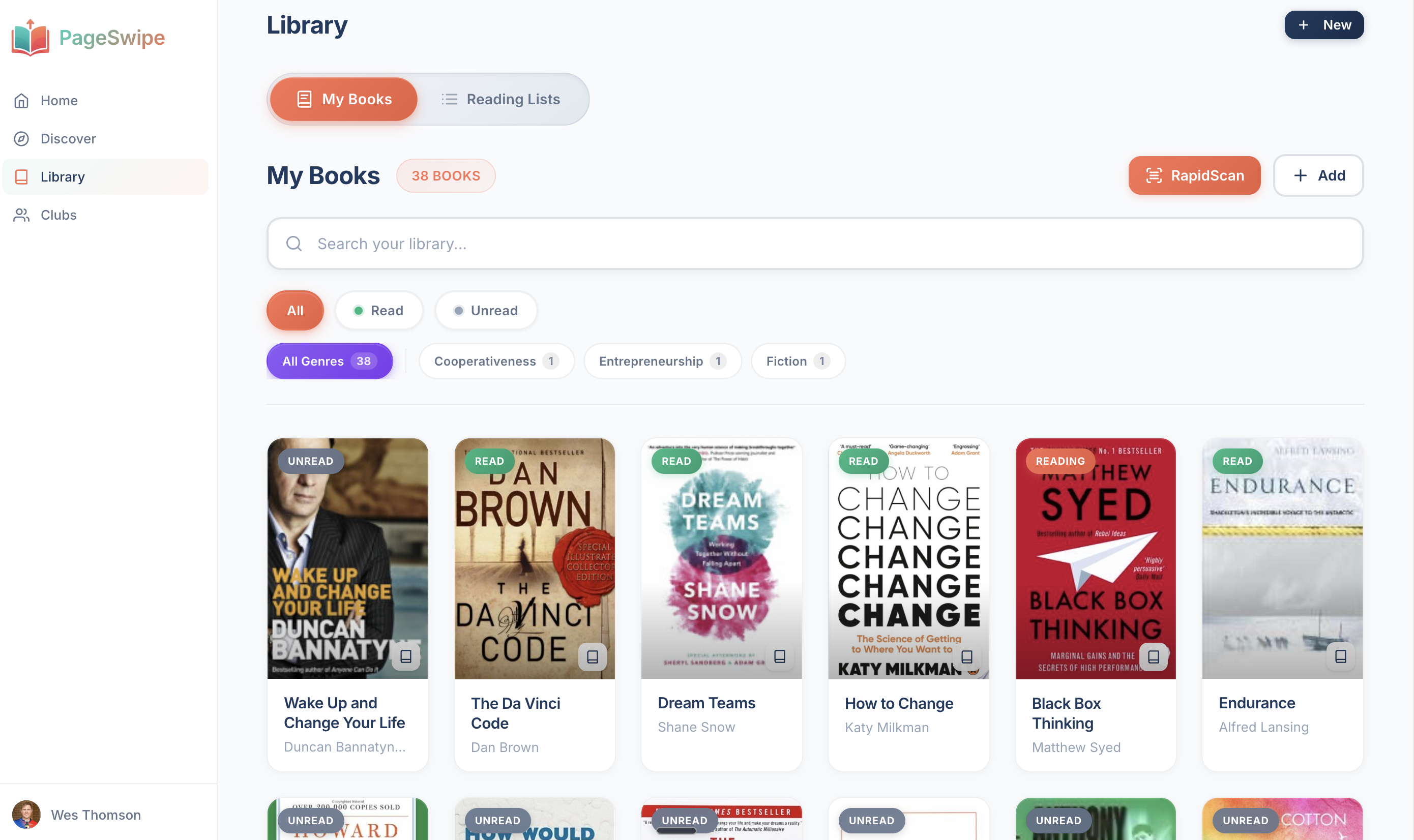
- A book page readers can share. Your book gets an official page — cover, description, purchase and reading links — that a reader sends to a friend with one line instead of describing it from memory. That is the clean handoff word of mouth needs.
- A club they can bring friends into. Create a club around the book and invite your readers; those readers bring in people they know, so the book travels along real relationships.
- Discussion questions that spark clubs. Add your questions to the book page so any group can pick it up — and when one club talks about your book, its members carry it into the next. One club recommends into another.
PageSwipe is a free platform for readers and authors: scanning, cataloguing, sharing, lending, clubs, collections, discovery, book pages, and launch clubs are not gated. PageSwipe earns revenue through book-native advertising with authors and publishing houses at scale.
Putting it together
Getting readers to recommend your book is the sum of small, honest choices: a book that earns it, a hook they can repeat, a page they can share, questions that start conversations, an ask at the right moment, and reviews you never tamper with. Do those and you are clearing the path for word of mouth, not manufacturing it. Two companion guides go wider: how to get your book in front of new readers covers reaching people who have not heard of you yet, and how to build a readership from scratch is the long game of growing an audience. For the author tools on PageSwipe, see the for-authors overview and the guide to turning readers into a group at get book club readers. Readers can see the other side of the loop in the book club app, and there is more at pageswipe.tech.
Frequently asked questions
How do you get readers to recommend your book?
Make the book easy to recommend, then ask at the right moment. Give readers a one-line hook they can repeat, a single page they can share instead of describing the book from memory, and discussion questions that spark conversation. Then ask when they have just finished and are still enthusiastic — for one specific action, such as telling a friend or sharing your book page. You cannot manufacture word of mouth, but you can remove the friction that stops a willing reader from passing the book on.
Why is word of mouth so important for books?
Because a book is a high-trust, high-time purchase, and a personal recommendation carries more weight than any advertisement. When a friend says a book is worth your evenings, that is credibility no marketing can buy. Word of mouth also compounds — one reader tells two, each of those tells others — and keeps finding readers long after any launch push has ended. It is the most durable, lowest-cost engine a book has.
When is the best time to ask a reader to recommend your book?
The moment they finish, while the ending is still fresh — the peak of enthusiasm. A short note at the back of the book, an email a day or two after a reader marks it finished, or a prompt inside a reading group all work. Ask for one small, specific thing rather than a vague favour, and never before the reader has really experienced the book.
How do I get honest reviews without paying for them?
Ask real readers directly and make it specific and easy: point them to where a review helps and tell them their honest opinion — good or bad — is what you want. Never pay for positive reviews, offer rewards tied to a rating, or run review swaps. Those practices break most retailer policies and mislead readers. An honest three-star review from a real reader is worth more than a bought five-star one.
Does PageSwipe find readers for my book?
No. PageSwipe does not supply or manufacture an audience. It gives your book a home where the readers you invite can gather, talk about it, and recommend it onward into their own circles. You bring a book worth recommending and invite your own readers; PageSwipe gives those readers the tools to spread it — a shareable book page, a club they can bring friends into, and discussion questions that start new conversations.
Give your book a home readers can recommend from
You bring the book worth talking about and the readers you already have. PageSwipe gives them one clean place to share it, discuss it and bring friends in — the recommendation stays theirs.
Create your free PageSwipe book page and give your readers something easy to pass on — free, with no cap on the books you add.