How to Find Readers for Your First Book
By The PageSwipe Team · 4 July 2026
Finishing a first book is hard. Finding people to read it can feel harder. Almost every debut author hits the same wall: the manuscript is done, the cover looks right, the file is uploaded — and then the quiet sets in. No queue of readers appears just because a book exists. This is an honest, practical guide to where your first readers actually come from, how to reach them without a big platform, and how to give them something worth passing on. We will be straight with you throughout, including about what PageSwipe can and cannot do.
The short answer
You find readers for a first book by starting with the people already within reach and widening out one channel at a time — people you know, niche communities, a small newsletter, ARC and beta readers, and book clubs — then giving that first core an easy way to gather around the book and recommend it onward. Reach is built through small, consistent actions, not one launch-day push. And no tool hands you an audience: your job is to invite real readers; the right home for the book just makes it easier for them to take part and spread the word.
TL;DR
- Start with who you already know. Your first ten readers are almost never strangers.
- Go where your subject already lives. Niche communities beat broad broadcasting for a debut.
- Build a small list you own. A modest newsletter outperforms a large, borrowed social following.
- Use ARC and beta readers. Early readers create early word of mouth and honest reviews.
- Give readers something to do together. A launch club and discussion questions turn readers into recommenders.
- Be honest about the mechanics. No platform supplies an audience — you invite readers; a good home helps them spread it.
First, the honest part: nobody hands you readers
It is worth saying plainly, because a lot of author marketing implies otherwise. There is no service, app, or algorithm that produces readers for your first book on demand. Advertising can buy attention, but attention is not readership, and a debut budget rarely stretches far. The uncomfortable truth is the freeing one: your first readers come from relationships and relevance, and both are things you can build deliberately, starting today, for free.
So treat this as a craft, not a lottery. The authors who find their footing are not the ones with the biggest launch — they are the ones who kept doing small, consistent things: talking to the right communities, emailing the people who cared, and making it genuinely easy for one reader to hand the book to the next.
How to find your first readers, step by step
Work these in order. Each step feeds the next, and none of them requires a large following or a marketing budget.
- List the people already within reach. Friends, family, former colleagues, classmates, anyone who followed your writing, anyone connected to your book's subject. Write the actual names. This is your seed audience, and it is bigger than it feels.
- Find the niche where your book already belongs. Every book sits inside an existing interest — a genre, a profession, a hobby, a place, a life stage. Identify the forums, Discord servers, subreddits, Facebook groups, and local groups where those people already gather. You are not interrupting them; you are joining a conversation you belong in.
- Start a simple newsletter. A list of email addresses is the one audience you truly own — no algorithm sits between you and them. It can start with twenty people. Send something useful or human once or twice a month, not just "buy my book."
- Recruit ARC and beta readers. Advance and beta readers read early, give feedback, and — if they liked it — leave the first honest reviews and tell friends. Invite them directly and personally; a small, genuine group beats a large indifferent one.
- Take the book to book clubs. Book clubs are readers who have pre-agreed to read the same title and talk about it. A single club that picks your book can produce a dozen engaged readers and a wave of recommendations. Make it easy for them to choose you.
- Give your readers a home and a reason to recommend. Once people are reading, point them all to one place where they can discuss the book, answer questions, and pass it to their own reading circles. Word of mouth is the strongest force in bookselling, but it needs somewhere to happen.
- Repeat the small actions. One conversation, one email, one club, one review at a time. Consistency compounds; a single launch day does not.
Where to focus first
If the list above feels like a lot, do them in this priority order. Most debut authors overinvest in the last row and underinvest in the first.
- People you know — highest conversion, zero cost, available today.
- Niche communities — the fastest way to reach strangers who are actually the right readers.
- A newsletter — the audience you keep, regardless of any platform's changes.
- ARC / beta readers and book clubs — the engine of early reviews and recommendations.
- Broad social media — useful as a supporting layer, weakest as a starting point for an unknown name.
The pattern is simple: start narrow and warm, then widen. A hundred readers who care will carry a first book further than ten thousand followers who scroll past it.
The channels, compared
Here is an honest map of where debut readers come from, what each channel is good for, and the effort it takes. Treat it as a starting guide, not a rulebook — your book's subject will make some rows far stronger than others.
| Channel | Best for | Effort | Honest note |
|---|---|---|---|
| People you know | Your first 10–50 readers and reviews | Low | Highest conversion; feels awkward but works. Ask directly. |
| Niche communities | Reaching the right strangers | Medium | Contribute first; pitching cold gets ignored or removed. |
| Email newsletter | An audience you own long-term | Medium, ongoing | Slow to grow, but nothing sits between you and the reader. |
| ARC / beta readers | Early reviews and word of mouth | Medium | Ask for honest reviews only — never buy or swap positive ones. |
| Book clubs | Deep engagement and recommendations | Medium | One club can seed dozens of readers if you make it easy to pick you. |
| Broad social media | Supporting visibility over time | High, ongoing | Real but slow for an unknown name; not where to start. |
| Paid ads | Scaling something that already works | High + cost | Buys attention, not loyalty. Wasteful before you have traction. |
Illustrative guide only. Which channels work hardest depends entirely on your book's genre, subject and audience.
Turn readers into recommenders
Finding readers is only half the job. The other half is making it effortless for one reader to become two. Nearly every reader discovers new books the same way — a person they trust hands them one. Your task is to give that hand-off somewhere to happen.
Practically, that means giving the book a single home that does three things: it gathers your early readers in one place, it gives them something to do together beyond reading in silence, and it makes recommending the book onward a one-tap act rather than a chore. A book that lives only as a purchase link has no room for any of that. A book with a proper page, a place to discuss it, and a set of questions to spark conversation gives readers a reason to stay and to bring a friend.
Where PageSwipe fits — and where it does not
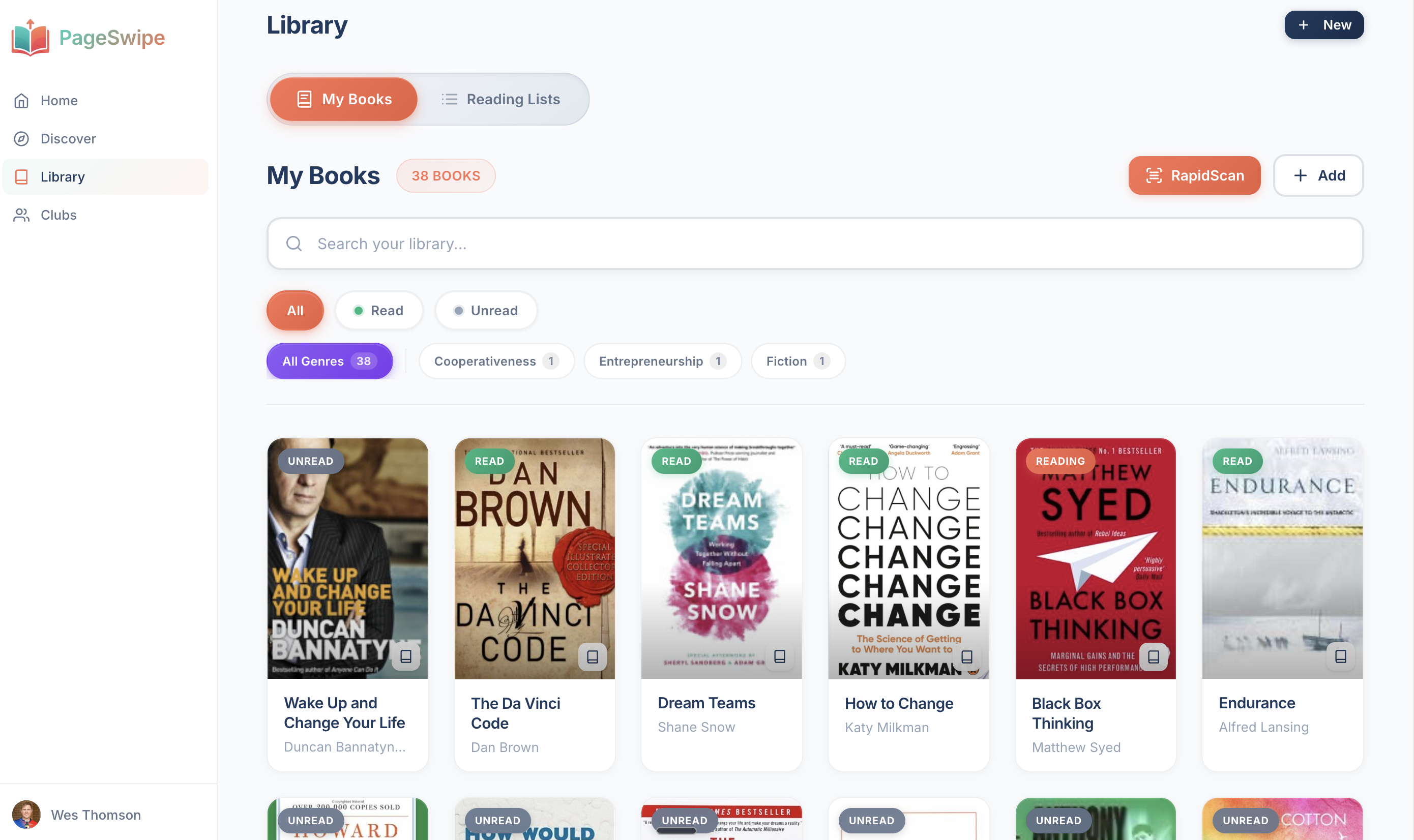
Here is the honest version, because it matters. PageSwipe does not find, supply, or manufacture readers for you. It will not hand you an audience, and any tool that promises to should be treated with suspicion. What PageSwipe gives your first book is a home: a proper book page (cover, description, ISBN, purchase and reading links), a launch club you can gather your early readers into, and discussion questions that give those readers something to talk about together.
The division of labour is simple. You bring and invite the readers — using exactly the channels above. PageSwipe's job starts once they arrive: it gives them a place to participate, discuss the book, vote on what the club reads next, and — the part that actually spreads a first book — recommend it onward to their own reading circles. It turns a scattered handful of early readers into a small community that can carry the book further than you can reach alone.
PageSwipe is a free platform for readers and authors: scanning, cataloguing, sharing, lending, clubs, collections, discovery, book pages, and launch clubs are not gated. PageSwipe earns revenue through book-native advertising with authors and publishing houses at scale.
A simple first-month plan
You do not need a grand strategy. You need a short list of small actions and the discipline to keep at them. Here is a plain four-week shape you can adapt.
- Week 1 — Gather. Write your list of people within reach. Set up your book's home page and a launch club so there is one place to point everyone.
- Week 2 — Invite. Personally invite your seed readers and a first round of ARC/beta readers. Add discussion questions so the club has life in it from day one.
- Week 3 — Widen. Show up in two or three niche communities where your book belongs. Contribute genuinely; mention the book where it is welcome, not everywhere.
- Week 4 — Spread. Ask your early readers for one honest thing each: a review, a club invite, or a recommendation to a single friend. Small asks, real people.
Repeat the parts that work. Reaching readers for a first book is rarely a single event; it is a habit you keep for months, and the compounding is the whole point.
Common mistakes to avoid
- Waiting for launch day to start. Readership is built before publication, not after. Begin gathering people while you still have a manuscript.
- Broadcasting instead of belonging. Posting "buy my book" into the void rarely works. Joining a community you genuinely belong to does.
- Chasing strangers before activating friends. Your warm circle converts far better than cold reach. Start there without embarrassment.
- Buying or swapping reviews. Honest reviews from real readers build trust; manipulated ones destroy it and can get you removed from retailers. Always ask for honest reactions only.
- Leaving readers with nowhere to gather. If the book is only a purchase link, there is no room for discussion or recommendation. Give it a home.
Keep going: two guides that go deeper
Finding your first readers is the start of a longer craft. If you are building from a standing start, our guide on how to build a readership from scratch covers the long game of growing an audience over time. And if you want the specific places to be visible, where new authors can share their books maps the channels in detail. For the full picture of how PageSwipe supports authors, start at the for authors overview or the dedicated find readers for your book page. You can also read more about the wider approach at pageswipe.tech.
Frequently asked questions
How do I find readers for my first book?
Start with the people already within reach — friends, family, colleagues, and anyone who followed your writing along the way — then widen out to niche communities where your subject already lives, a small email newsletter, ARC and beta readers, and book clubs. Reach is built one small, consistent action at a time, not in a single launch. Give those first readers an easy way to gather around the book and to recommend it onward to their own reading circles. No tool or platform automatically supplies you an audience; your job is to invite real readers and make it easy for them to bring others.
How many readers do I need for a first book launch?
Fewer than you think. A first book does not need thousands of readers to succeed — it needs a small core who genuinely read it, talk about it, and recommend it to others. A handful of engaged readers who each tell two friends will do more for a debut than a large, silent following. Focus on depth of engagement first, then let it spread.
Where can I find readers if I have no social media following?
You do not need a large following to find your first readers. Start with people you already know, then niche communities tied to your book's subject or genre, local book clubs and libraries, a simple newsletter, and beta or ARC readers you invite directly. These channels reward relevance and consistency, not follower counts, and they are how most debut authors reach their first hundred readers.
Does PageSwipe find readers for my book?
No. PageSwipe does not find, supply, or manufacture readers for you — it does not hand you an audience. What it gives your book is a home: a book page, a launch club, and discussion questions where the readers you invite can gather, take part, and recommend the book onward to their own reading circles. You bring the readers; PageSwipe helps them participate and spread the word.
What is the first thing I should do to get readers for a debut book?
Make a simple list of everyone who already knows you or your subject, and give the book one clear place to point them to. Before you chase strangers, activate the people within reach and give them something concrete to do — read an early copy, join a launch club, answer a discussion question, or recommend it to one friend. That first core is the seed everything else grows from.
Give your first book a home
Create your free PageSwipe book page, gather your early readers into a launch club, and give them something worth recommending onward. You bring the readers — PageSwipe gives the book a home where they can gather and spread it.